
Choose the character you will play. *Starred characters have larger speaking parts. The underlined characters are real people/animals.
Back to Teacher View
Student View
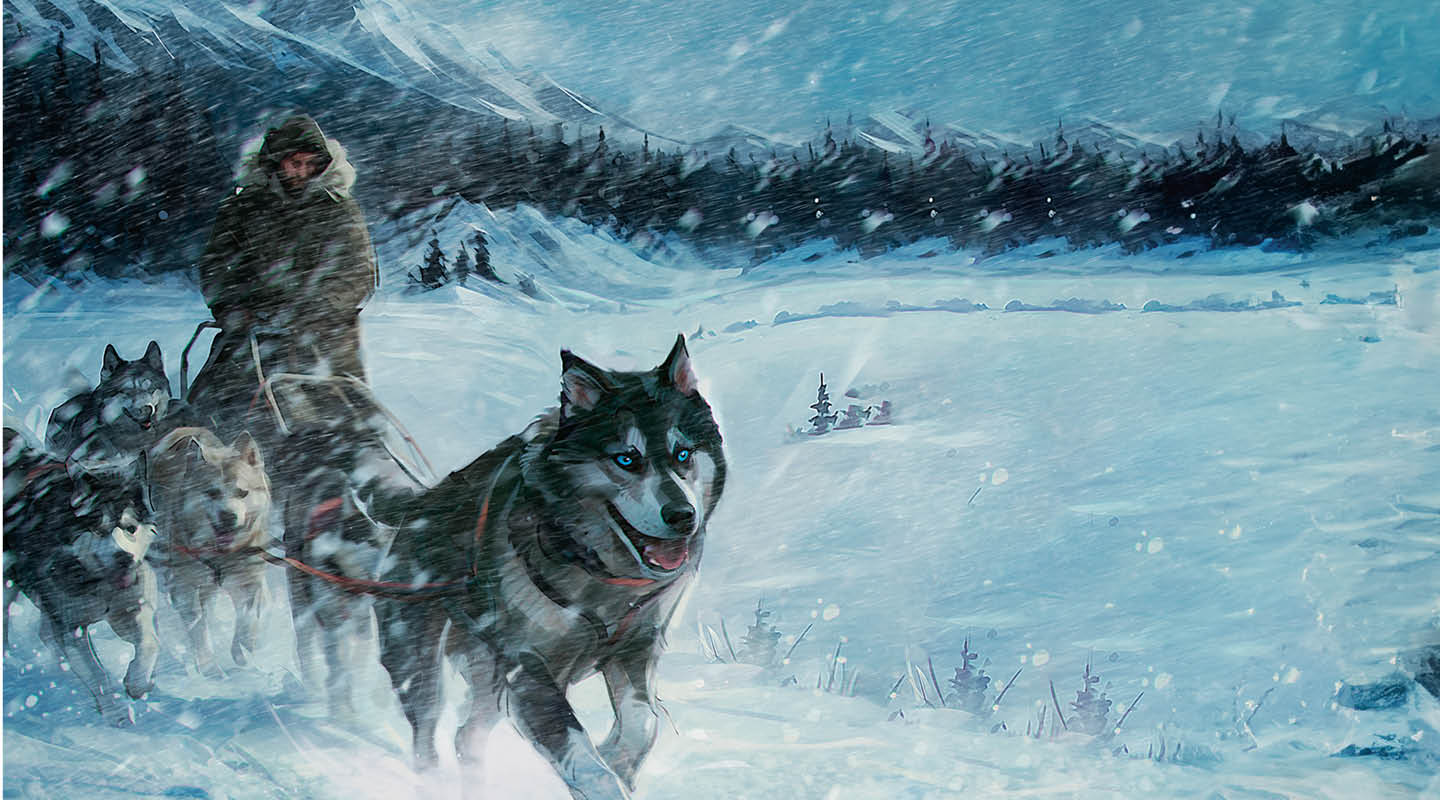
Art by Viktor Miller-Gausa

Race Across the Ice
Hundreds of lives depend on these dogs completing their mission. Will they make it in time?
CHARACTERS
*Historians 1 and 2 (H1, H2)
*Narrators 1 and 2 (N1, N2)
Helen, a 12-year-old girl
Albert, Helen’s 9-year-old brother
*Dr. Welch, the only doctor in town
Mama and Papa, Helen and Albert’s parents
*Mark Summers, head of Nome Health Board
*Leonhard Seppala (SEP-uh-luh), Bill Shannon, Henry Ivanoff, and Gunnar Kaasen (KA-shen), mushers, or dogsled drivers
Constance, Seppala’s wife
Togo and Balto, sled dogs
Train conductor
PROLOGUE
H1: Welcome to the small town of Nome, Alaska.
H2: Let’s go back about 100 years. At the time, Nome was one of the most isolated places you could live.
H1: No roads led to Nome. Supplies like food and medicine came by ship.
H2: But for seven months each year, the sea near Nome turned to solid ice.
H1: And the weather was too cold for airplanes.
H2: The only way to get supplies in winter was by dogsled.
H1: Dogsled drivers were known as mushers. And dogsledding was very dangerous.
H2: Dogs often got lost in storms and froze. Some fell through the ice and drowned.
H1: The mushers’ lives depended on their dogs.
H2: And in January 1925, the lives of many children in Nome depended on them too.
The Granger Collection
Nome, Alaska
Alaska Native peoples have lived in the Nome area for about 10,000 years. In 1925, 455 Alaska Natives and 975 White people lived in Nome. They worked together to get the medicine. Most of the dogsled drivers were Alaska Natives.
SCENE 1
Helen and Albert’s house, January 22, 1925
N1: A horrible illness is spreading through Nome.
N2: Two children have died.
N1: Albert lies in bed, his face hot and sweaty.
N2: His sister pats his forehead with a damp cloth.
Helen: You’ll feel better soon, Albert.
Albert: What if it’s the sickness those kids had?
Helen: Maybe it’s just a really bad cold.
N1: Mama and Papa enter with Dr. Welch.
Dr. Welch: How long has Albert’s throat been sore?
Mama: Four days, and his fever won’t go down.
Dr. Welch (to Albert): Open your mouth and say “Ah.”
Albert: Ahhhhhh.
N2: Dr. Welch takes Mama and Papa aside.
Dr. Welch: Albert has diphtheria (dif-THIHR-ee-uh), I’m afraid.
Mama: Is there medicine?
Dr. Welch: Yes. It’s called antitoxin. I ordered it last summer, but it never came.
Papa: Can Albert get better without it?
Dr. Welch (looking grim): I’m afraid not.
Mama (crying): How can we help him?
Dr. Welch: He needs the antitoxin. I’ll do everything I can to get it.
SCENE 2
Town hall, two days later
The Granger Collection
An Alaska Native woman ice fishing in the early 1900s
N1: Town leaders hold an emergency meeting.
Mark Summers: Good news! There’s antitoxin in Anchorage.
Dr. Welch: How can we get it here?
Summers: Airplane would be fastest, but the plane engines are frozen. The best solution is to put the medicine on a train to Nenana. Then a dogsled team can bring it to Nome.
Dr. Welch: But Nenana to Nome is nearly 700 miles! The dogs will need to rest along the way. It will take them three weeks! There must be a faster way.
Summers: How about a relay of dogsled teams? They can hand the medicine off to each other. We’ll send teams out from Nenana and Nome. They’ll meet in the middle so we don’t lose time.
Dr. Welch: That’s a great idea!
Summers: Leonhard Seppala’s team is the fastest. Let’s have him do the longest stretch.
Dr. Welch: We’ll find other mushers to wait at rest stops along the trail.
SCENE 3
Leonhard Seppala’s house, later that day
N2: Summers hurries to Seppala’s home.
N1: He finds him and his wife in the yard with dozens of dogs barking loudly.
Summers: Leonhard, we have an emergency. We need you to dogsled 300 miles east to Nulato.
Seppala: That’s halfway to Nenana. What’s in Nulato?
Summers: The medicine that will save these sick children. Another musher will be heading west from Nenana to give it to you.
Constance: That’s a treacherous trip.
Summers: Yes, but Leonhard knows these trails best.
Seppala: Not as well as my lead dog, Togo.
N2: Seppala ruffles the fur of a fluffy husky.
Constance: But there’s a storm coming!
Seppala: That won’t stop me.
Summers: Just don’t take a shortcut across the Norton Sound—it’s not safe. Go around.
Seppala: Togo and I will check it out.
Constance: You think you’ll save time, Leonhard, but you could fall through the ice!
Seppala: Togo could cross an icy sea blindfolded, right, boy?
Togo: Arf! Arf!
Constance: But Leonhard—
Seppala: People are counting on me. I won’t let Nome down.
Design Pics Inc/Alamy Stock Photo
A Long History
Humans have likely been traveling by dogsled for thousands of years. For centuries, dogsleds were key to survival for people in many areas of Alaska.
Every dogsled team has a musher, or driver.
SCENE 4
Nenana, January 27, 1925, nighttime
N1: In dim moonlight, a train chugs into Nenana.
N2: The conductor hops off with a crate wrapped in thick brown cloth.
N1: He hands the crate to a man in a heavy fur coat, musher Bill Shannon.
Train Conductor: Here’s the medicine.
Bill Shannon: Got it.
N2: Shannon ties the crate to his sled and climbs on.
Conductor: You’re leaving now? In the dark?
Shannon: Yes. The next driver is waiting in Tolovana.
Conductor: That’s 50 miles. The trip will take two days.
Shannon: I’ll try to do it in one push. The dogs are ready. And so am I.
Jim McMahon/Mapman ®
The Race to Nome
The medicine’s journey began in Anchorage. It was then brought by train to Nenana. Finally, 20 dogsled teams worked together to get the medicine to Nome.
SCENE 5
Norton Sound, January 28, 1925
N1: Far to the west, Seppala and his dogs reach the edge of a frozen bay—the Norton Sound.
N2: Seppala gets off his sled and walks to the front of the pack.
Seppala: Togo, should we go for it? Will the ice hold? It will save us a day.
Togo: Arf! Arf!
Seppala: OK, let’s do it.
N1: In freezing wind, they begin to cross 42 miles of ice.
N2: The dogs’ paws slide. Togo veers to avoid a crack.
Seppala: Good boy!
N1: They keep going.
SCENE 6
Helen and Albert’s house, January 29, 1925
N2: At least 20 people are sick now.
N1: Albert is in the hospital.
N2: Meanwhile, Helen is home with her parents. Her dad is reading the newspaper.
Papa (reading aloud): “Dogsled drivers are traveling day and night to bring the antitoxin to Nome. More teams are joining to help.”
Mama: Wonderful!
Helen (reading over Papa’s shoulder): “Now the meeting point for Seppala’s dogsled has moved closer to Nome.”
Mama: How will Seppala know? He was told to pick up the medicine farther east.
Helen: It says the mushers will have to find each other on the trail.
Papa: Heaven help them.
SCENE 7
The trail, January 31, 1925
N1: Seppala is quickly heading east.
N2: At the same time, musher Henry Ivanoff is heading west. But he struggles to control his dogs.
Henry Ivanoff: Whoa!
N1: Ivanoff stops the dogs— and sees Seppala’s dogsled speeding down the trail.
N2: Ivanoff runs through deep snow, waving his arms at Seppala and shouting.
N1: Seppala can’t hear him.
Seppala (to himself) : Sorry, no time to stop.
N2: Seppala’s sled is whizzing past.
Ivanoff: SEPPALA! STOP!
N1: Seppala slams on the brake.
Ivanoff: I have the antitoxin!
Seppala: I thought I had 100 miles to go.
Ivanoff: They added more teams. Take the medicine and head back to Nome. Other mushers are waiting.
N2: Seppala turns Togo and the other dogs around.
Seppala: Come on, Togo!
Togo: Arf!
piemags/ww2archive/Alamy Stock Photo (1941); National Museum of American History, Smithsonian Institution (Vaccine)
Dangerous Disease
Diphtheria is a fast-spreading illness that affects the nose and throat. Today it is rare. That’s because there is a vaccine, or medicine, that helps prevent it.
SCENE 8
Thirty miles outside Nome, February 1, 1925
N1: With the weather getting worse, Seppala hands off the antitoxin to the next team.
N2: Finally, the medicine reaches Gunnar Kaasen.
N1: His dogsled team is led by a brown dog named Balto.
N2: The dogs race through the snow. But soon a blizzard roars. It’s hard to see.
Gunnar Kaasen (shouting at his dogs): Haw!
N1: Suddenly, the wind flips the sled onto its side. The dogs whine, tangled.
N2: Kaasen fixes the sled.
Kaasen (worried): Where’s the antitoxin?
N1: He searches the snow.
Kaasen: Oh no! Please no!
N2: Just then, Kaasen feels the edge of the crate and lifts it onto the sled.
Kaasen: Whew! Now it’s up to you, Balto!
Balto: Woof!
N1: Balto takes off.
N2: When they reach the next rest stop, everything is dark.
Kaasen (to himself) : The next driver must be asleep. It’ll take too long to get his dogs ready.
N1: Kaasen looks at Balto.
Kaasen: Can you make it all the way to Nome, boy?
Balto: Woof! Woof!
SCENE 9
Nome, February 2, 1925
N2: Just before dawn, Helen hears barking.
N1: She rushes to the window just in time to see Kaasen and his dogs flying by.
Helen: Mama! Papa! They’re here!
N2: Kaasen stops the sled near the hospital and lugs the medicine inside.
Kaasen: Here you go, Doc.
Dr. Welch: You came through the storm? And the antitoxin is fine? You did it!
Kaasen (shaking his head): The dogs did.
EPILOGUE
H1: It’s one of history’s most incredible stories.
H2: Hundreds of lives were saved because of 20 mushers and their amazing dogs.
Ivanoff: Going from Nenana to Nome by dogsled usually took 25 days. We did it in five and a half.
Seppala: Togo was already 12, an old dog, when he made the trip.
Kaasen: It was our toughest journey ever, but I knew Balto could do it.
H1: The truth is, the children of Nome could not have been saved without the speed and courage of these amazing dogs
George Rinhart/Corbis via Getty Images (Leonhard Seppala); Andrew Harrer/Bloomberg via Getty Images (Balto);
Hero Dogs
Balto became a hero after the medicine arrived in Nome. (There’s even a statue of him in New York City!) But today Leonhard Seppala’s lead dog, Togo, is also honored for his bravery. He led the longest, most dangerous part of the race.
videos
(1)
Skills Sheets
(4)
Skills Sheets
(4)
Skills Sheets
(4)
Skills Sheets
(4)
Lesson Plan
(1)
Text-to-Speech