
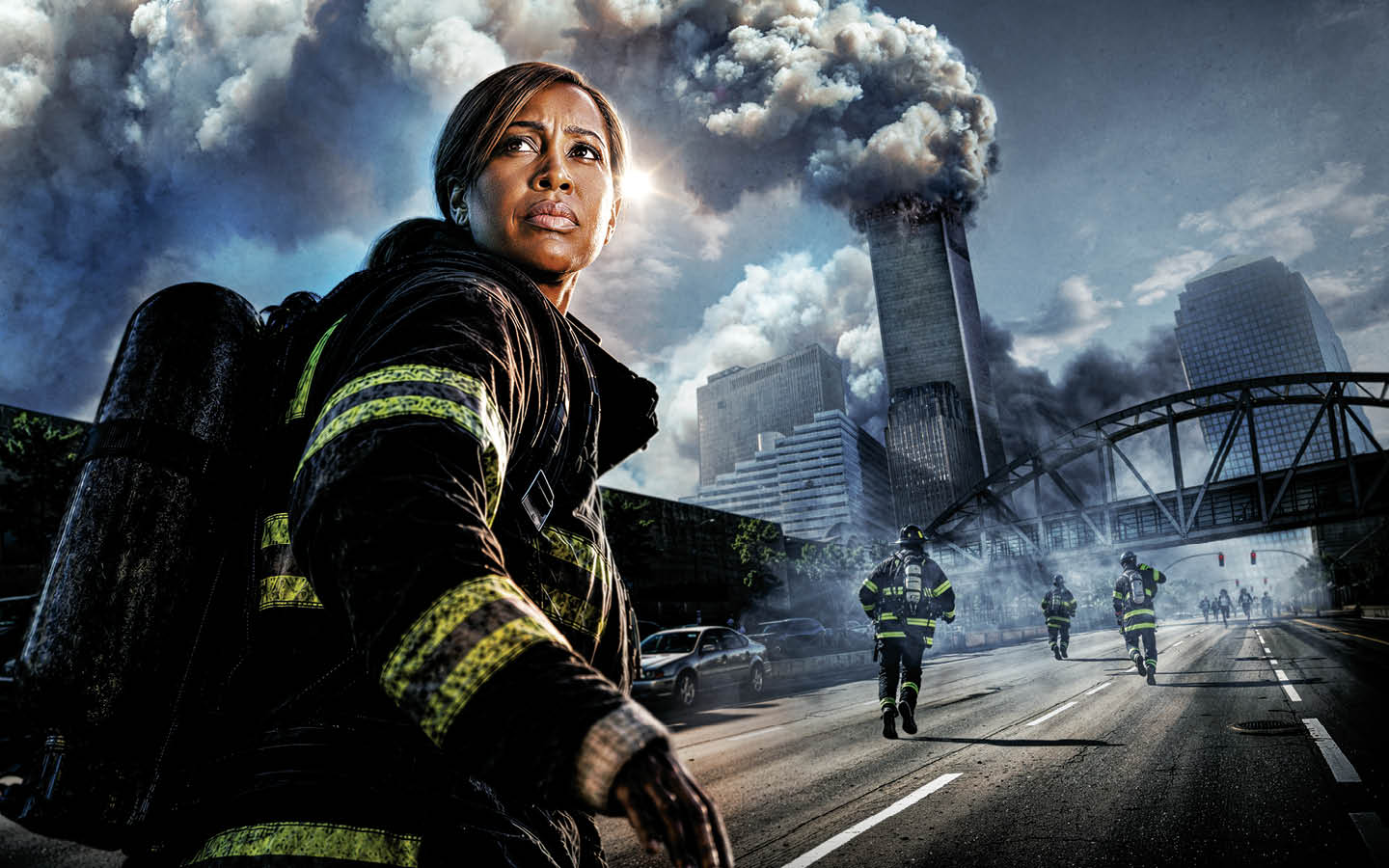

A firefighter in full gear stands on a city street as smoke billows from a tall building behind her and other firefighters run toward it

Art by Randy Pollak

Standards

Into the Choking Smoke

On September 11, hundreds of heroes rushed toward disaster as others escaped. This is firefighter Regina Wilson’s incredible story.  

Before You Read: Check out our Background Builder slideshow


    We’re under attack! Run! Run!” 

    The warning came over firefighter Regina Wilson’s radio. She sprinted to her fire engine. As she did, a huge cloud of black smoke rushed down the street toward her. 

    Then everything went dark. All she could hear was a loud roar. 

    It was September 11, 2001. Lower Manhattan—a busy area of New York City—was full of people running for their lives. But Wilson and other first responders couldn’t run away. 

    They had a job to do.

    So instead of fleeing the disaster, they were rushing toward it.

    Would they make it out alive?

    We’re under attack! Run! Run!

    The warning came over firefighter Regina Wilson’s radio. She raced to her fire engine.

    A huge cloud of black smoke rushed toward her. Then everything went dark. All she could hear was a loud roar.

    It was September 11, 2001. Lower Manhattan, a busy area of New York City, was full of people running for their lives. But Wilson and other first responders couldn’t run away.

    They had a job to do. Instead of fleeing the disaster, they were rushing toward it.

    Would they make it out alive?

    We’re under attack! Run! Run!

    The warning came over firefighter Regina Wilson’s radio, and she sprinted to her fire engine. As she did, an enormous cloud of black smoke rushed down the street toward her.

    Then everything went dark. All Wilson could hear was a loud roar.

    It was September 11, 2001. Lower Manhattan—a busy area of New York City—was crowded with people running for their lives. But Wilson and other first responders couldn’t run away.

    They had a job to do.

    So instead of fleeing the disaster, they were rushing toward it.

    Would they make it out alive?

The Trade

Courtesy of Regina Wilson 

John Chipura (left) and Regina Wilson worked at the same firehouse.

    Wilson joined the Fire Department of the City of New York (FDNY) in 1999. By 9/11, she had been a firefighter for two years. She worked at Engine 219/Ladder 105. That’s a firehouse in Brooklyn. Around 8 a.m., Wilson was just finishing an overnight shift. Her boss asked her if she could stay on for the day shift. 

    Wilson wanted some extra pay and experience, so she agreed.

    At first, Wilson was assigned to Ladder 105, a fire truck. (That’s the vehicle with a ladder and tools for busting into flaming buildings.) Then a firefighter named John Chipura asked for a favor. He wanted more experience on the truck. But he was assigned to Engine 219. (An engine is the vehicle that carries water and long hoses for putting out fires.) Would Wilson trade with him?

    Being a firefighter wasn’t always easy for Wilson. As a Black woman, she often found herself feeling left out at the firehouse. But Chipura was different. He always treated her with kindness. They spent hours laughing and talking about their lives. She was happy to say yes to her good friend. 

    Neither one of them could have imagined what would happen next.

    Wilson joined the Fire Department of the City of New York (FDNY) in 1999. By 9/11, she had been a firefighter for two years. She worked at Engine 219/Ladder 105. That’s a firehouse in Brooklyn. Around 8 a.m., Wilson was finishing an overnight shift. Her boss asked her to stay on for the day shift.

    Wilson wanted some extra pay and experience, so she agreed.

    At first, Wilson was assigned to Ladder 105, a fire truck. (That’s the vehicle with a ladder and tools for busting into flaming buildings.) Then a firefighter named John Chipura asked for a favor. He wanted more experience on the truck. But he was assigned to Engine 219. (An engine is the vehicle that carries water and long hoses for putting out fires.) Would Wilson trade with him?

    Being a firefighter wasn’t always easy for Wilson. As a Black woman, she often felt left out at the firehouse. But Chipura was different. He was always kind to her. They spent hours laughing and talking. She was happy to say yes to her good friend.

    They could never have imagined what would happen next.

    Wilson joined the Fire Department of the City of New York (FDNY) in 1999. By 9/11, she had been a firefighter for two years. She worked at Engine 219/Ladder 105, a firehouse in Brooklyn. Around 8 a.m., Wilson was just finishing an overnight shift. Her boss asked her if she could stay on for the day shift.

    The idea of getting some extra pay and experience appealed to Wilson, so she agreed.

    Initially, Wilson was assigned to Ladder 105, a fire truck. (That’s the vehicle with a ladder and tools for busting into flaming buildings.) Then a firefighter named John Chipura asked her for a favor. He wanted more experience on the truck, but he was assigned to Engine 219. (An engine is the vehicle that carries water and long hoses for putting out fires.) Would Wilson be willing to trade places with him?

    Being a firefighter wasn’t always easy for Wilson. As a Black woman, she often felt somewhat disconnected and different from her co-workers at the firehouse. But Chipura was an exception—he always treated her with kindness, and the two spent hours laughing and talking about their lives. Wilson was happy to say yes to her good friend’s request.

    Neither one of them could possibly have envisioned what would happen next.

Jeff Overs/BBC News & Current Affairs via Getty Images (Twin Towers); Jim McMahon/Mapman ® (Map)

The Towers
The Twin Towers were part of the World Trade Center. It was a huge office and shopping complex in lower Manhattan. 

Under Attack

    Not even an hour later, Wilson heard shouting. It was coming from the firehouse’s kitchen. She ran there to see what was happening. Her co-workers were watching TV. On the screen were New York City’s Twin Towers—two of the tallest buildings in the world. And one of them had a giant flaming hole in its side. 

    As Wilson would soon learn, the United States was under attack by a group called Al Qaeda. The group was based in Afghanistan, a country in Asia. It was led by a man named Osama bin Laden. Bin Laden and the men who carried out the attacks were terrorists. (Those are people who use fear or violence to gain power.)

    On September 11, Al Qaeda members took control of four airplanes. Then they crashed them on purpose. One hit the Pentagon, the headquarters of the U.S. military. Another crashed in a field in Pennsylvania. The other two were flown into the Twin Towers. 

    These skyscrapers were part of a big office and shopping complex called the World Trade Center. About 50,000 people went to work there each day. Another 70,000 visited or passed through. For many people, these buildings were symbols of America’s strength and power. 

    Not even an hour later, Wilson heard shouting. It was coming from the firehouse’s kitchen. She ran over. Her co-workers were watching TV. On the screen were New York City’s Twin Towers—two of the tallest buildings in the world. One of them had a huge, flaming hole in its side.

    The United States was under attack by a group called Al Qaeda. The group was based in Afghanistan, a country in Asia. It was led by a man named Osama bin Laden. Bin Laden and the men who carried out the attacks were terrorists. (Those are people who use fear or violence to gain power.)

    On September 11, Al Qaeda members took control of four airplanes. Then they crashed them on purpose. One hit the Pentagon, the headquarters of the U.S. military. One crashed in a field in Pennsylvania. The other two were flown into the Twin Towers.

    These skyscrapers were part of a big office and shopping complex called the World Trade Center. About 50,000 people worked there each day. Another 70,000 visited or passed through. For many people, the buildings were symbols of America’s power.

    Not even an hour later, Wilson heard shouting coming from the firehouse’s kitchen and hurried over to see what was happening. She found her co-workers watching television. On the screen were New York City’s Twin Towers, two of the tallest buildings in the world—and one of them had a massive, flaming hole in its side.

    As Wilson would soon learn, the United States was under attack by a group called Al Qaeda. The group was based in Afghanistan, a country in Asia, and was led by a man named Osama bin Laden. Bin Laden and the men who carried out the attacks were terrorists—people who use fear or violence to gain power.

    On September 11, Al Qaeda members took control of four airplanes and intentionally crashed them. One plane hit the Pentagon, the headquarters of the U.S. military. Another crashed in a field in Pennsylvania. The other two were flown into the Twin Towers.

    These skyscrapers were part of a large office and shopping complex called the World Trade Center. About 50,000 people went to work there each day, and another 70,000 visited or passed through. For many people, these immense structures were symbols of America’s strength and power.

Maurice Savage/Alamy Stock Photo (Newspaper); Amy Sancetta/AP Images (Fleeing)

The Terror
On the morning of September 11, planes flew into the Twin Towers. Less than two hours later, the buildings collapsed. The area was full of people running from danger.

Into the Chaos

    Back at the firehouse, Chipura’s truck was called out first. Wilson’s engine left next. 

    It raced through the streets of Brooklyn and into a tunnel to Manhattan (see map above). 

    On the other side of the tunnel, the engine entered total chaos. The South Tower had just collapsed. The air was full of smoke. Hundreds of people were running down the street, covered in ash. They looked like ghosts. 

    Wilson and her fellow firefighters knew that help was needed at the North Tower. But on the way there, they heard a terrifying noise.

    BOOM! BOOM! BOOM! 

    It was the sound of the North Tower collapsing floor by floor. 

    That’s when the voice on the radio told Wilson to run. She wondered if she was about to die. Then her mind turned to Chipura and the men on Ladder 105. They had left 40 minutes before she did. 

    Could they have been inside one of the towers?

    At the firehouse, Chipura’s truck was called out first. Wilson’s engine left next.

    It raced through the streets of Brooklyn and into a tunnel to Manhattan (see map above).

    On the other side of the tunnel, the engine entered total chaos. The South Tower had just collapsed. The air was full of smoke. Hundreds of people were running down the street, covered in ash. They looked like ghosts.

    Wilson and her fellow firefighters knew that help was needed at the North Tower. But on the way there, they heard a scary noise.

    BOOM! BOOM! BOOM!

    It was the sound of the North Tower collapsing floor by floor.

    That’s when the voice on the radio told Wilson to run. She wondered if she was about to die. Then she thought of Chipura and the men on Ladder 105. They had left 40 minutes before she did.

    Could they have been in one of the towers?

    Back at the firehouse, Chipura’s truck was called out first. Wilson’s engine left next, racing through the streets of Brooklyn and into a tunnel to Manhattan (see map above).

    On the other side of the tunnel, the engine emerged into total chaos. The South Tower had just collapsed, and the air was thick with smoke. Hundreds of people were running down the street, covered in ash. They looked like ghosts.

    Wilson and her fellow firefighters knew that help was needed at the North Tower—but on the way there, they heard a terrifying noise.

    BOOM! BOOM! BOOM!

    It was the sound of the North Tower collapsing floor by floor.

    That’s when the voice on the radio told Wilson to run. She wondered if she was about to die. Then her thoughts turned to Chipura and the men on Ladder 105, who had left the firehouse 40 minutes before she had.

    Could they have been inside one of the towers?

Still Missing

    After the smoke cleared, Wilson and the other first responders stayed focused on their jobs. They put out fires. They helped people who were hurt.  

    Throughout it all, Wilson prayed that her co-workers were still alive. At one point, she called her family: “I told them I loved them. I said that if I died, I would have died doing what I loved.”

    Finally, late that night, Wilson returned to her firehouse. She lay down on the floor and fell asleep right away. Ladder 105 hadn’t yet returned. But Wilson hoped the men were simply still hard at work at the Trade Center.

    After the smoke cleared, Wilson and the other first responders kept working. They put out fires. They helped people who were hurt.

    Wilson prayed that her co-workers were still alive. At one point, she called her family: “I told them I loved them. I said that if I died, I would have died doing what I loved.”

    Late that night, Wilson returned to her firehouse. She lay down on the floor and fell asleep. Ladder 105 hadn’t yet returned. Wilson hoped the men were safe.

    After the smoke cleared, Wilson and the other first responders remained focused on their duties. They put out fires and helped people who were injured.

    Throughout the ordeal, Wilson prayed for her co-workers’ survival. At one point, she called her family. “I told them I loved them,” she recalls. “I said that if I died, I would have died doing what I loved.”

    Finally, late that night, Wilson returned to her firehouse. She lay down on the floor and immediately fell asleep. Ladder 105 hadn’t yet returned, but Wilson held out hope that the men were simply still hard at work at the World Trade Center.

Spencer Platt/Getty Images (Escorting); Shawn Baldwin/AP Images (Rubble)

The Heroes
Hundreds of first responders rushed to the scene of the attacks. With their help, more than 25,000 people made it out of the towers before they collapsed. Another 20 were rescued from the site later.

Acts of Kindness

    When Wilson woke up the next morning, Chipura and the other men on the truck still weren’t there. Nobody could reach them. 

    Meanwhile, neighbors were gathering to see how they could help. Some brought meals. A woman who lived nearby brought Wilson hairpins. These small acts of kindness meant everything after such a horrible day. 

    That kindness also helped the firefighters when they received terrible news. The Ladder 105 crew had been helping people escape from the South Tower when the building had collapsed. 

    All six men were believed to be dead.

    When Wilson woke up the next morning, Chipura and the other men on the truck still weren’t there. Nobody could reach them.

    Meanwhile, neighbors came to offer help. Some brought meals. A woman brought Wilson hairpins. These acts of kindness meant everything after such a horrible day.

    That kindness also helped the firefighters when they got terrible news. The Ladder 105 crew had been helping people escape from the South Tower when the building collapsed.

    All six men were believed to be dead.

    When Wilson woke up the next morning, Chipura and the other men on the truck still weren’t there—and nobody could reach them.

    Meanwhile, neighbors were gathering to see what they could do to help. Some of them brought meals. A woman who lived nearby brought Wilson hairpins. These small acts of kindness meant everything after such a horrible day.

    That kindness also comforted the firefighters when they received devastating news. The Ladder 105 crew had been helping people escape from the South Tower when the building collapsed.

    All six men were believed to be dead.

Honor and Remember

Alberto E. Rodriguez/Getty Images 

The Hope
Since 9/11, Wilson has found comfort in telling Chipura’s story.

    The 9/11 terrorist attacks shocked the world. Nearly 3,000 people were killed. That number included 343 members of the FDNY. 

    The FDNY’s job wasn’t over once the fires were put out. Firefighters helped search the site of the attacks for victims. Through the end of 2001, Wilson spent her days at Ground Zero, as many called it. It was hard work. But even on their days off, Wilson and other firefighters showed up to help. 

    Today Wilson is still a proud member of the FDNY. In the years since 9/11, she has felt guilty. She struggles with the fact that Chipura died and she didn’t. She knows it could have been her instead.

    That’s why she keeps telling his story. “I want people to remember him,” she says. “He was a true hero. Every time I say his name, he lives.”

    Wilson also has a message for people like you who didn’t live through 9/11. “Bad things happen all the time,” she says. “Sometimes you can control it. Most of the time you can’t.”

    But you can still hold on to hope and kindness. “People have this heartfelt desire to help others,” she says. “That’s what we’re on this Earth for.”

    The 9/11 attacks shocked the world. Nearly 3,000 people were killed. Among them were 343 members of the FDNY.

    The FDNY’s job wasn’t over once the fires were put out. Firefighters searched the area for victims. Wilson spent months working at Ground Zero, as many called it. It was hard work. But even on their days off, Wilson and other firefighters showed up to help.

    Today Wilson is still a proud member of the FDNY. In the years since 9/11, she has felt guilty. She struggles with the fact that Chipura died and she didn’t. She knows it could have been her instead.

    That’s why she keeps telling his story. “I want people to remember him,” she says. “He was a true hero. Every time I say his name, he lives.”

    Wilson has a message for young people. “Bad things happen all the time,” she says. “Sometimes you can control it. Most of the time you can’t.”

    But you can still hold on to hope and kindness. “People have this heartfelt desire to help others,” she says. “That’s what we’re on this Earth for.” 

    The 9/11 terrorist attacks shocked the world. Nearly 3,000 people were killed, including 343 members of the FDNY.

    The FDNY’s work wasn’t over once the fires were extinguished. Firefighters helped search the site of the attacks for victims. Through the end of 2001, Wilson spent her days at Ground Zero, as many called it. It was difficult work—but even on their days off, Wilson and other firefighters showed up to help.

    Today Wilson is still a proud member of the FDNY. In the years since 9/11, she has struggled with feelings of guilt over the fact that Chipura died and she didn’t. She’s all too aware that it could have been her instead.

    That’s why she keeps telling his story. “I want people to remember him,” she explains. “He was a true hero. Every time I say his name, he lives.”

    Wilson also has a message for people like you who didn’t experience the horrors of 9/11. “Bad things happen all the time,” she says. “Sometimes you can control it. Most of the time you can’t.”

    But you can still hold on to hope and compassion. “People have this heartfelt desire to help others,” she says. “That’s what we’re on this Earth for.” 

Michael M. Santiago/Getty Images (Memorial)

The Hope
It has been 25 years since the attacks. The World Trade Center site now hosts a memorial, a museum, and several office towers. Together they are a symbol of New York City’s strength—and hope.

Background Builder

videos (1)
Skills Sheets (3)
Skills Sheets (3)
Skills Sheets (3)
Quizzes (1)
Lesson Plan (1)
Leveled Articles (2)
Quizzes (1)
Text-to-Speech