
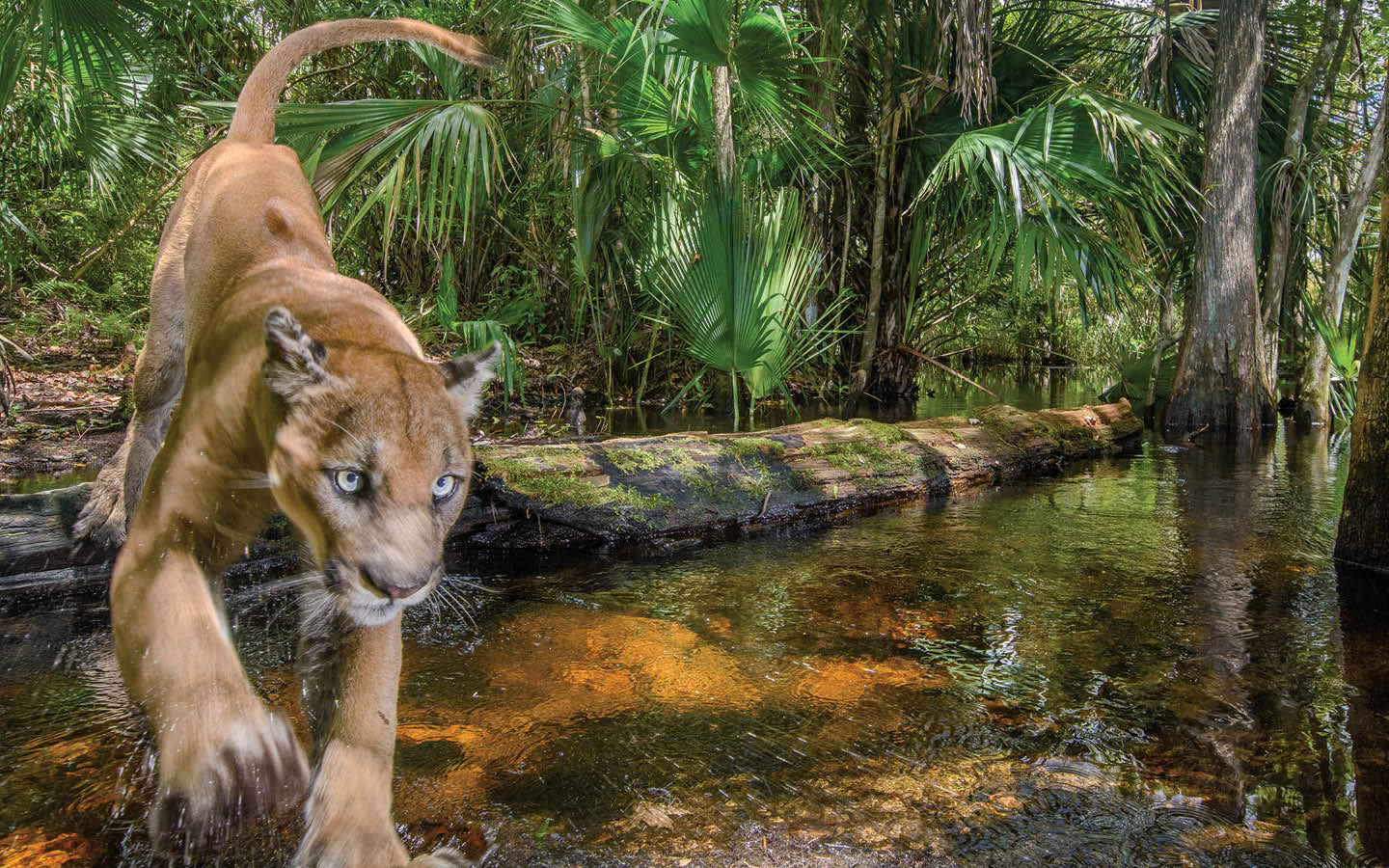

Image of panther walking through the woods

Carlton Ward Jr/CarltonWard.com 

CCSS

R.1, R.3, R.4, R.7, W.3, SL.1, L.4, L.6

Standards

Return of the Ghost Cat

Thousands of Florida panthers once roamed the U.S. Today only about 200 remain. Can these big cats make a comeback?  

Before You Read: Check out our Background Builder slideshow


USFWS/Florida Panther National Wildlife Refuge

Broketail’s name comes from the twist in her tail.

    It was a sunny day in 2021. A panther named Broketail was leading her three kittens through tall grasses in southern Florida. Up ahead was a shady tunnel beneath a busy highway.

    At just a few months old, the kittens had never seen or heard anything like it. The ground shook from the cars speeding above. The loud roar of trucks filled their ears. 

    Broketail stepped into the tunnel. But behind her, the nervous kittens cowered. 

    Broketail looked back and called to them. She knew that her little ones would have to learn to be brave. Using freeway crossings like this one was key to staying alive.

    Humans had built this crossing just for Broketail’s species, the Florida panther. Only about 200 of these cats were still alive in the wild. They needed all the help they could get. Would Broketail be able to teach her kittens to cross?

    It was a sunny day in 2021. A panther named Broketail led her three kittens through tall grasses in southern Florida. Up ahead was a tunnel beneath a busy highway.

    The kittens were just a few months old. The tunnel scared them. The ground shook from the cars speeding above. The loud roar of trucks filled their ears.

    Broketail stepped into the tunnel. But behind her, the nervous kittens cowered.

    Broketail looked back. She called to the kittens. She knew they had to learn to be brave. Using freeway crossings like this one was key to staying alive.

    Humans had built this crossing just for Broketail’s species, the Florida panther. Only about 200 of these cats were still alive in the wild. The animals needed help. Would Broketail be able to teach her kittens to cross?

    On a sunny day in 2021, a panther named Broketail was leading her three kittens through tall grasses in southern Florida. Up ahead was a shady tunnel beneath a busy highway.

    At just a few months old, the kittens had never seen or heard anything like it. The ground shook from the cars speeding above, and the loud roar of trucks filled their ears.

    Broketail stepped into the tunnel—but behind her, the nervous kittens cowered.

    Broketail looked back and called to them. She knew that her little ones would have to learn to be brave. Using freeway crossings like this one was key to their survival.

    Humans had constructed this crossing especially for Broketail’s species, the Florida panther. With only about 200 of these cats still alive in the wild, they needed all the help they could get. Would Broketail be able to teach her kittens to cross?

The Ghost Cat

Jim McMahon/Mapman ® (Map)

Where Panthers Live
Today Florida panthers live only in southern Florida. But their range was once much, much larger.

    Thousands of Florida panthers could once be found across the Southeastern United States. But in 1513, Spanish colonists arrived in Florida. They spotted the panthers. And the animals terrified them. The colonists told each other stories of violent panthers. They even said the animals were attacking their babies. 

    In reality, Florida panthers usually avoid humans. (Their shy, silent ways have earned them a nickname: “Ghost Cat.”) But panthers were attacking sheep, goats, and cows. So the colonists shot any panthers they could find. 

    Florida became a state in 1856. By that time, its leaders wanted to get rid of panthers. They even awarded money for each panther killed. This caused the number of Florida panthers to drop sharply.

    The panthers that were left moved away from the areas where they were being hunted. Soon they lived only in the southern tip of Florida.

    Thousands of Florida panthers once roamed the Southeastern United States. But in 1513, Spanish colonists arrived in Florida. They saw the panthers. And they got scared. The colonists told stories about violent panthers. They even said the animals were attacking their babies.

    In truth, Florida panthers usually avoid humans. (Their shy, silent ways have earned them a nickname: “Ghost Cat.”) But panthers were attacking sheep, goats, and cows. So the colonists shot any panthers they could find.

    Florida became a state in 1856. Its leaders wanted to get rid of panthers. They awarded money for each panther killed. And so the number of Florida panthers dropped sharply.

    The panthers that were left moved away from the areas where they were being hunted. Soon they lived only in the southern tip of Florida.

    Thousands of Florida panthers could once be found across the Southeastern United States. But in 1513, Spanish colonists arrived in Florida. They spotted the panthers, and the animals terrified them. The colonists told each other stories of violent panthers. They even said the animals were attacking their babies.

    In reality, Florida panthers usually avoid humans. (Their shy, silent ways have earned them the nickname “Ghost Cat.”) But panthers were attacking sheep, goats, and cows—so the colonists shot any panthers they could find.

    Florida became a state in 1856. By that time, its leaders wanted to get rid of panthers. They even awarded money for each panther killed. This caused the number of Florida panthers to drop sharply.

    The panthers that remained moved away from the areas where they were being hunted. Soon they lived only in the southern tip of Florida.

Carlton Ward Jr/CarltonWard.com

Room to Roam
A mom travels with her kittens. Florida panthers need huge areas of land to be able to hunt and breed.

Building Up

Shutterstock.com

Risky Roads
In Florida, humans have built roads and highways through panthers’ natural homes. Crossing them can be dangerous—even deadly.

    In 1900, experts believed there were about 500 panthers left in Florida. By the 1960s, that number had dropped to fewer than 20. At the same time, the number of people grew. In the 1950s and 1960s, more than 200,000 people moved to Florida each year. 

    All of those people needed houses to live in. They needed places to shop. There had to be roads to connect growing cities. 

    To build all these things, swamps were drained. Forests were cut down. The panthers’ habitat shrank.

    Even wild areas were divided by roads. And this was a big problem. Why? 

    Panthers need huge areas of land to hunt and to breed. Now they could not roam freely without coming up against speeding cars.

    By the 1970s, Florida panthers were in danger of dying out completely. 

    In 1900, experts believed there were about 500 panthers left in Florida. By the 1960s, that number had dropped to fewer than 20. At the same time, the number of people grew. In the 1950s and 1960s, more than 200,000 people moved to Florida each year.

    Those people needed houses to live in. They needed places to shop. There had to be roads to connect growing cities.

    To build all these things, swamps were drained. Forests were cut down. The panthers’ habitat shrank.

    Even wild areas were divided by roads. This was a big problem. Why?

    Panthers need huge areas of land to hunt and to breed. Now they could not roam freely without facing speeding cars.

    By the 1970s, Florida panthers were in danger of dying out completely.

    In 1900, experts believed there were about 500 panthers left in Florida. By the 1960s, that number had dropped to fewer than 20. At the same time, the number of people grew. In the 1950s and 1960s, more than 200,000 people moved to Florida each year.

    All of those people needed houses to live in and places to shop. There had to be roads to connect growing cities.

    To build all these things, swamps were drained and forests were cut down. As a result, the panthers’ habitat shrank.

    Even wild areas were divided by roads—and this was a major problem. Why?

    Panthers need huge areas of land to hunt and to breed. Now they could not roam freely without coming up against speeding cars.

    By the 1970s, Florida panthers were in danger of dying out completely.

Protecting Animals

    Around the same time, though, a big change was happening. Starting in the 1960s, Americans came to understand that human activity was affecting animals. The country’s first-ever endangered species list was created in 1966. And the Florida panther was on it. This made hunting the animal illegal.

    Then, in the 1990s, scientists worked to find new ways to help Florida panthers breed. The number of panthers in the wild grew to about 60. 

    Yet it still wasn’t enough to save the panther. As the number of panthers grew, experts wondered: Where would these panthers live? 

    In order to survive, they needed thousands of square miles of land to roam freely. That did not exist in southwest Florida at the time.

    Around the same time, though, a big change was happening. Starting in the 1960s, Americans came to understand something: Human activity affects animals. The country’s first-ever endangered species list was created in 1966. The Florida panther was on it. This made hunting the animal illegal.

    In the 1990s, scientists found new ways to help Florida panthers breed. The number of panthers in the wild grew to about 60.

    Still, there was a problem. As the number of panthers grew, experts wondered: Where would these panthers live?

    To survive, they needed thousands of square miles of land to roam freely. That did not exist in southwest Florida at the time.

    Around the same time, though, a big change was happening. Starting in the 1960s, Americans came to understand that human activity was affecting animals. The country’s first-ever endangered species list was created in 1966, and the Florida panther was on it. This made hunting the animal illegal.

    Then, in the 1990s, scientists worked to find new ways to help Florida panthers breed. The number of panthers in the wild grew to about 60.

    Yet it still wasn’t enough to save the panther. As the number of panthers grew, experts wondered: Where would these panthers live?

    In order to survive, they needed thousands of square miles of land to roam freely—and that didn’t exist in southwest Florida at the time.

Solving the Problem

Doug Engle Photography

Wildlife crossings are also built over highways. This one is above Florida’s I-75.

    Before long, scientists and lawmakers joined together. They wanted to find a way to connect natural lands in Florida. Their goal was to create a big piece of land where panthers and other animals could safely roam. They later called it the Florida Wildlife Corridor. 

    Experts figured out where animals often tried to cross busy roads. Then they built wildlife crossings. These are special bridges or underpasses that animals can use. The crossings help them get from one side to the other safely. 

    Wildlife groups also bought and protected more land for panthers. And together with the wildlife crossings, it worked. Today more than 6,000 square miles of natural land in south Florida is part of the Florida Wildlife Corridor. 

    Scientists and lawmakers joined together. They wanted to find a way to connect natural lands in Florida. Their goal was to create a big piece of land where panthers and other animals could safely roam. They later called it the Florida Wildlife Corridor.

    Experts figured out where animals often tried to cross busy roads. Then they built wildlife crossings. These are special bridges or underpasses that animals can use. The crossings help them get from one side to the other safely.

    Wildlife groups also bought and protected more land for panthers. And along with the wildlife crossings, it worked. Today more than 6,000 square miles of natural land in south Florida is part of the Florida Wildlife Corridor.

    Before long, scientists and lawmakers joined together to find a way to connect natural lands in Florida. Their goal was to create a big piece of land where panthers and other animals could safely roam. They later called it the Florida Wildlife Corridor.

    Experts figured out where animals often tried to cross busy roads. Then they built wildlife crossings: special bridges or underpasses that animals can use to get from one side to the other safely.

    In addition, wildlife groups bought and protected more land for panthers—and together with the wildlife crossings, these efforts led to something really valuable. Today more than 6,000 square miles of natural land in south Florida is part of the Florida Wildlife Corridor.

Matthew Mccollister/The National Park Service 

Crossing Safely 
A Florida panther walks through a highway underpass. More than 6,000 square miles of natural land in south Florida is part of the Florida Wildlife Corridor.

New Hope

Shutterstock.com 

A Serious Stare
The Florida panther belongs to a species of wild cat called a puma. Other pumas include mountain lions and Texas cougars.

    That brings us back to that sunny day in 2021. A wildlife camera filmed Broketail and her babies at the underpass. After several hours, she finally got them to make it across. 

    And less than a year later, those three kittens were caught on camera again. By then, they were nearly full-grown. They traveled through that same underpass bravely.

    Today Broketail is 13. That’s older than most Florida panthers in the wild. Experts say she probably wouldn’t have lived more than one or two years without wildlife crossings.

    There’s still more work to be done to save the Florida panther. But about 200 of these big cats now roam freely in the southern part of the state. Their story is proof that humans can hurt animals—but help them too. 

    That brings us back to that sunny day in 2021. A wildlife camera filmed Broketail and her babies at the underpass. It took hours, but she finally got them to cross.

    Less than a year later, those three kittens were caught on camera again. By then, they were nearly full-grown. They went through that same underpass bravely.

    Today Broketail is 13. That’s older than most Florida panthers in the wild. Experts say she probably wouldn’t have lived more than one or two years without wildlife crossings.

    There’s still more work to be done to save the Florida panther. But about 200 of these big cats now roam the southern part of the state. Their story shows that humans can hurt animals—but help them too.  

    That brings us back to that sunny day in 2021. A wildlife camera filmed Broketail and her babies at the underpass. After several hours, she finally got them to make it across.

    And less than a year later, those three kittens were caught on camera again. By then, they were nearly full-grown. They traveled through that same underpass bravely.

    Today Broketail is 13, which is older than most Florida panthers in the wild. Experts say she probably wouldn’t have lived more than one or two years without wildlife crossings.

    There’s still more work to be done to save the Florida panther, but approximately 200 of these big cats now roam freely in the southern part of the state. Their story is proof that humans can hurt animals—but help them too.  

ACTIVITY: 
Finding Text Evidence

You’ve just read “Return of the Ghost Cat.” Now it’s time to do this activity.

Tip: Text evidence means details in a story that support an answer or show that it is true.

What to do: Use text evidence—or details from the article—to answer the questions below. We did the first one for you.

You’ve just read “Return of the Ghost Cat.” Now it’s time to do this activity.

Tip: Text evidence means details in a story that support an answer or show that it is true.

What to do: Use text evidence—or details from the article—to answer the questions below. We did the first one for you.

You’ve just read “Return of the Ghost Cat.” Now it’s time to do this activity.

Tip: Text evidence means details in a story that support an answer or show that it is true.

What to do: Use text evidence—or details from the article—to answer the questions below. We did the first one for you.

What happened to the number of Florida panthers after state leaders started awarding money for each panther killed?

HINT: Look for the answer in the section “The Ghost Cat.”

Answer: After Florida leaders started awarding money for every panther killed, the number of panthers dropped sharply.

What happened to the number of Florida panthers after state leaders started awarding money for each panther killed?

HINT: Look for the answer in the section “The Ghost Cat.”

Answer: After Florida leaders started awarding money for every panther killed, the number of panthers dropped sharply.

What happened to the number of Florida panthers after state leaders started awarding money for each panther killed?

HINT: Look for the answer in the section “The Ghost Cat.”

Answer: After Florida leaders started awarding money for every panther killed, the number of panthers dropped sharply.

What happened to the number of Florida panthers after their habitat shrank in the mid-1900s?

HINT: Look for the answer in the section “Building Up.”

What happened to the number of Florida panthers after their habitat shrank in the mid-1900s?

HINT: Look for the answer in the section “Building Up.”

What happened to the number of Florida panthers after their habitat shrank in the mid-1900s?

HINT: Look for the answer in the section “Building Up.”

What happened to the number of Florida panthers after scientists tried to find new ways to help them breed in the 1990s?

HINT: Look for the answer in the section “Protecting Animals.”

What happened to the number of Florida panthers after scientists tried to find new ways to help them breed in the 1990s?

HINT: Look for the answer in the section “Protecting Animals.”

What happened to the number of Florida panthers after scientists tried to find new ways to help them breed in the 1990s?

HINT: Look for the answer in the section “Protecting Animals.”

How old is Broketail? How long would she have likely lived without wildlife crossings?

HINT: Look for the answer in the section “New Hope.”

How old is Broketail? How long would she have likely lived without wildlife crossings?

HINT: Look for the answer in the section “New Hope.”

How old is Broketail? How long would she have likely lived without wildlife crossings?

HINT: Look for the answer in the section “New Hope.”

Think About It! What do your answers tell you about the effect humans can have on animals?

Think About It! What do your answers tell you about the effect humans can have on animals?

Think About It! What do your answers tell you about the effect humans can have on animals?

Background Builder

videos (1)
Skills Sheets (9)
Skills Sheets (9)
Skills Sheets (9)
Skills Sheets (9)
Skills Sheets (9)
Skills Sheets (9)
Skills Sheets (9)
Skills Sheets (9)
Skills Sheets (9)
Lesson Plan (1)
Leveled Articles (2)
Text-to-Speech