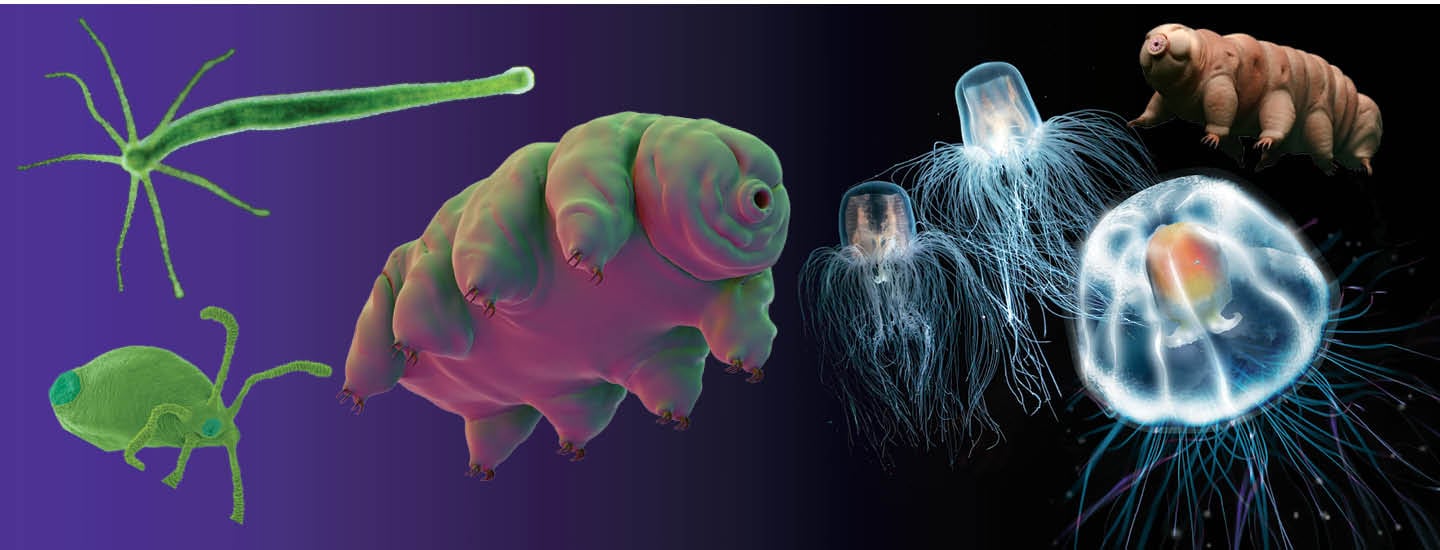
Image of a variety of creatures of all shapes, colors, and sizes

iStockPhoto/Getty Images (Tardigrades, Jellyfish); Shutterstock.com (Hydra Monster); Natural Visions/Alamy Stock Photo (Chlorohydra); Dennis Kunkel Microscopy/Science Source (Hydra); Adisha Pramod/Alamy Stock Photo (Jellyfish)

CCSS

L.4

Standards

What Do These Things Have in Common?

They all have superpowers . . . that could help them live forever!  

Test Your Knowledge! How much do you know about prefixes Take this quiz to find out .


What to do: Read the article. Then go back and look for eight words that contain the prefix in-, il-, im-, or ir-. We underlined the first one for you. Choose three of the words and write their definitions on a piece of paper. Use context clues or a dictionary for help.

Shutterstock.com

The hydra is named after this lake monster from Greek mythology. 

    A tiny creature floats through the water, hunting for food. 

    Then suddenly . . . Snap! A fish chomps off the creature’s head. 

    You might think that was the end for the little creature. But you’d be incorrect. Over the next few days, the creature grows a new head. Then it continues hunting.

    Does that sound impossible

    Not for the hydra, an organism named after a lake monster from Greek mythology. The hydra has an incredible ability to regrow its body parts. This allows it to survive many wounds and diseases—and to avoid the effects of old age.

    Today scientists are studying the hydra and other animals like it. They want to know: Can these creatures show us how to live forever?

Special Powers

Dennis Kunkel Microscopy/Science Source

The hydra

    All living things are made up of tiny building blocks called cells. Most cells have special jobs. For example, blood cells carry oxygen throughout our bodies.

    As we age, our cells work less well. The result? Skin droops, and muscles weaken.

    But the hydra is different. Its body is made up mostly of special cells called stem cells. These cells constantly renew themselves. If the hydra loses a body part, the stem cells can grow into whatever the hydra needs. Some scientists think the hydra could live forever. 

    And the hydra isn’t alone. The so-called immortal jellyfish can make its cells younger. That sounds illogical. But the animal can basically turn itself from an adult jellyfish back into a baby. 

    Some turtles also barely seem to age because their cells repair themselves. And a very tiny animal called the tardigrade is thought to be nearly indestructible: It can survive for decades in a sleeplike state.


Unlocking Secrets 

iStockPhoto/Getty Images

The tardigrade

    Scientists are working to understand these creatures and their powers. Could their discoveries help humans live forever? And if so, would you find that chance irresistible? 

    It’s improbable that you’ll live forever. But these discoveries might help us live longer. Maybe we’ll even be able to meet our great-great-great-grandchildren. 

    Unless a giant fish bites off our heads, of course! 

videos (1)
Skills Sheets (1)
Text-to-Speech