

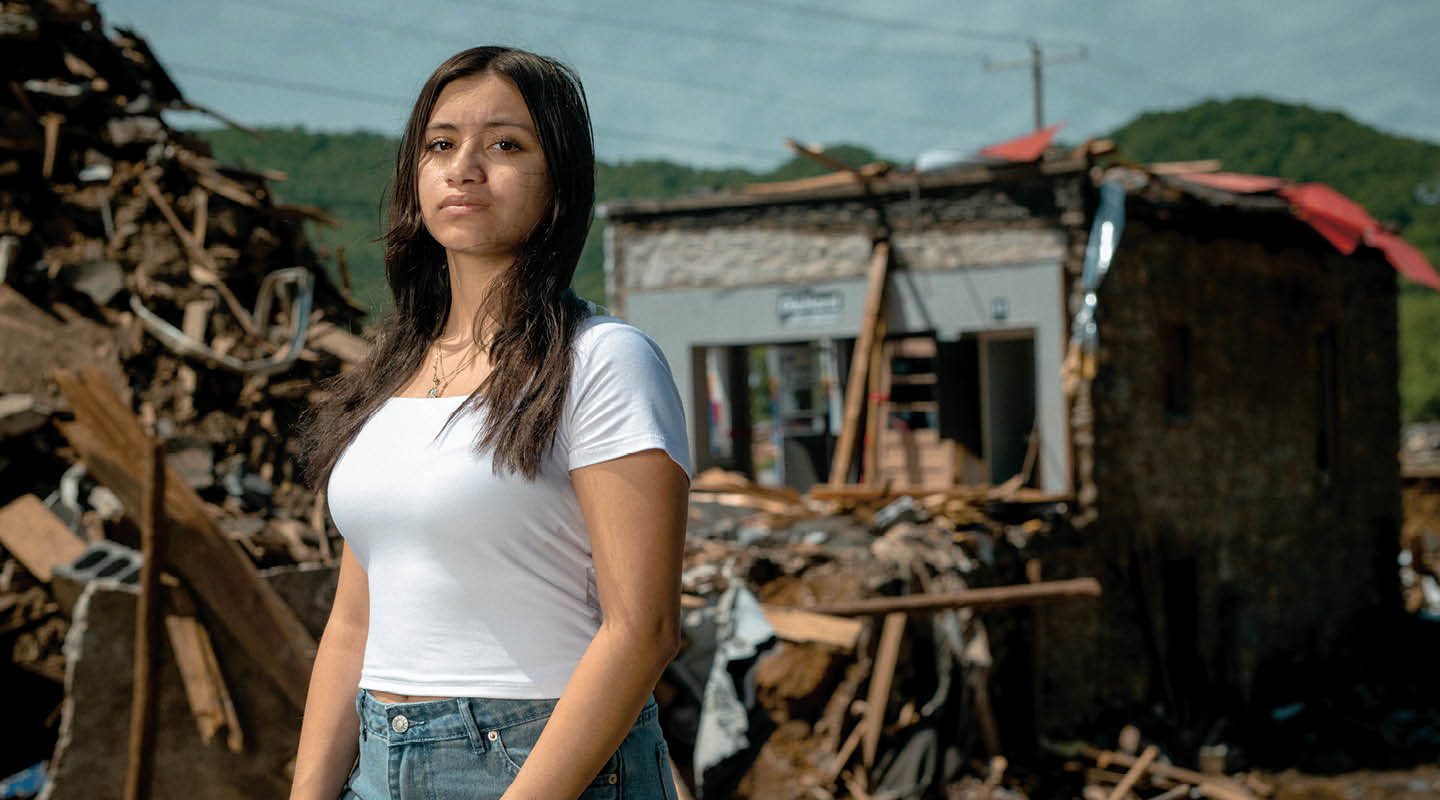

Photo of student standing in front of destruction

CCSS

R.1, R.2, R.3, R.4, R.7, W.2, SL.1, L.4, L.6

Standards

Surviving the Storm

Last September, parts of western North Carolina were destroyed by deadly flooding. This is the story of how Evelyn, 15, made it through the disaster—and came out stronger.  

Before You Read: Check out our Background Builder slideshow


    Evelyn Sarellano Paez had just woken up. And she could already tell something was wrong.

    It was September 27, 2024. The 15-year-old’s parents were talking in quiet, worried voices. Her brother was staring out the window. Her dog was nervously watching them.

    “What’s going on?” Evelyn asked. Her family told her to take a look outside. 

    Through the window, Evelyn saw a scary scene: Rain was pouring down. Giant trees were snapping like twigs. Muddy brown water was swirling around their house. 

    Hurricane Helene had hit Florida the night before. Evelyn had known that the storm was headed their way. But like many people, she thought it would get much weaker first.

    Now the muddy water was rising higher and higher. It showed no signs of slowing down. 

    The family had to get out—now.

    Evelyn Sarellano Paez had just woken up. And she already knew something was wrong.

    It was September 27, 2024. The 15-year-old’s parents were talking in worried voices. Her brother was staring out the window. Her dog looked nervous.

    “What’s going on?” Evelyn asked. Her family told her to look outside.

    Evelyn looked out the window. Rain was pouring down. Huge trees were snapping like twigs. Water was swirling around their house.

    Hurricane Helene had hit Florida the night before. Evelyn had known the storm was headed their way. But like many people, she thought it would get much weaker first.

    Now the water was rising. The family had to get out—fast.

    Evelyn Sarellano Paez had just woken up, and she could already tell something was wrong.

    It was September 27, 2024. The 15-year-old’s parents were talking in quiet, worried voices. Her brother was staring out the window. Her dog was anxiously watching them.

    “What’s going on?” Evelyn asked. Her family told her to take a look outside.

    Through the window, Evelyn saw a frightening scene: rain pouring down, giant trees snapping like twigs, and muddy brown water swirling around their house.

    Hurricane Helene had hit Florida the night before. Evelyn had known that the storm was headed their way—but like many people, she thought it would get much weaker first.

    Now the muddy water was rising higher and higher, and it showed no signs of slowing down.

    The family had to get out—now.

iStockPhoto/Getty Images 

Before the Storm
The Asheville, North Carolina, area is known for its leafy mountains and stunning natural beauty. 

Beautiful and Safe

    Just a few weeks earlier, Evelyn had started 10th grade. Her brother, Sebastian, was a senior. Both were on the cross-country team. In her spare time, Evelyn loved going on practice runs. She often jogged through the hilly park near her house. The family lived in Swannanoa, North Carolina. It’s just outside the city of Asheville.

    The Asheville area is known for its natural beauty. The city sits between two mighty rivers and is surrounded by mountains. In recent years, many people have moved to the area. They have been drawn to its leafy hiking trails and charming art galleries. 

    The weather in Asheville has pulled them there too. Temperatures are pleasant most of the year. And the area has often been said to be safe from extreme weather events, like hurricanes.

    A few weeks earlier, Evelyn had started 10th grade. Her brother, Sebastian, was a senior. Both were on the cross-country team. Evelyn loved going on practice runs. She often jogged through the park near her house. The family lived in Swannanoa, North Carolina. It’s just outside the city of Asheville.

    The Asheville area is known for its beauty. The city sits between two rivers. It’s surrounded by mountains. In recent years, many people have moved to the area. They like its hiking trails and art galleries.

    The weather has been a draw too. Temperatures are pleasant most of the year. And the area has often been said to be safe from extreme weather events, like hurricanes.

    Only a few weeks earlier, Evelyn had started 10th grade. She and her brother, a senior named Sebastian, were both on the cross-country team. Evelyn enjoyed going on practice runs, and she often jogged through the hilly park near her house. The family lived in Swannanoa, North Carolina—just outside the city of Asheville.

    The Asheville area is known for its natural beauty. The city sits between two mighty rivers and is surrounded by mountains. Many people have relocated to the area in recent years, attracted by its leafy hiking trails and charming art galleries.

    The weather in Asheville has drawn people there too. Temperatures there are pleasant most of the year, and the area has often been said to be safe from extreme weather events, like hurricanes.

A Soaked Sponge

    Evelyn and her family hadn’t been too worried about Helene. Hurricanes usually weaken as they move over land. And Helene was set to strike northwest Florida first. That’s more than 400 miles away from Asheville. 

    But Helene was no ordinary storm. 

    Nearly a week before, the hurricane began forming in the Caribbean Sea. The water and air there were abnormally warm at the time. Those high temperatures meant there was a lot of moisture in the air. Heavy rain clouds took shape. 

    Helene hit Florida late on September 26. The hurricane brought 140-mile-per-hour winds and giant waves. It then headed toward nearby states. In the early morning of September 27, Helene reached Asheville. 

    By that time, the winds had slowed down. But the storm had sucked up a lot of extra water on its journey over the warm ocean. Moisture-filled air slammed up against the mountains. Rain poured down over the area. 

    “Imagine a water-soaked sponge hitting a wall,” says Samuel Muñoz. He’s an extreme weather expert. “You’re squeezing out a lot of water quickly.”

    Soon the area’s two main rivers overflowed. In just hours, Asheville was disappearing under muddy water.

    Evelyn and her family hadn’t been too worried about Helene. Hurricanes usually weaken as they move over land. And Helene was set to hit northwest Florida first. That’s more than 400 miles from Asheville.

    But Helene was different. Nearly a week before, the hurricane began forming in the Caribbean Sea. The water and air there were abnormally warm at the time. The high temperatures caused a lot of moisture in the air. Heavy rain clouds took shape.

    Helene hit Florida on September 26. The storm brought 140-mile-per-hour winds and huge waves. It then headed for nearby states. Early on September 27, it reached Asheville.

    By that time, the winds had slowed down. But the storm had sucked up a lot of extra water as it passed over the warm ocean. Moisture-filled air slammed against the mountains. Rain poured down over the area.

    “Imagine a water-soaked sponge hitting a wall,” says Samuel Muñoz. He’s an extreme weather expert. “You’re squeezing out a lot of water quickly.”

    Soon the area’s two main rivers overflowed. In just hours, Asheville was disappearing under muddy water.

    Evelyn and her family hadn’t been especially worried about Helene. Hurricanes usually weaken as they move over land, and Helene was set to strike northwest Florida first. That’s more than 400 miles away from Asheville.

    But Helene was no ordinary storm.

    Nearly a week earlier, the hurricane had begun forming in the Caribbean Sea. The water and air there were abnormally warm at the time. Those high temperatures meant there was a lot of moisture in the air, and heavy rain clouds took shape.

    Helene struck Florida late on September 26, bringing 140-mile-per-hour winds and massive waves. It then headed toward nearby states. In the early morning of September 27, Helene reached Asheville.

    By that time, the winds had slowed down—but the storm had sucked up a considerable amount of extra water on its journey over the warm ocean. Moisture-filled air slammed up against the mountains, and immense quantities of rain poured down over the area.

    “Imagine a water-soaked sponge hitting a wall,” explains Samuel Muñoz, an extreme weather expert. “You’re squeezing out a lot of water quickly.”

    Before long, the area’s two main rivers overflowed. In just hours, Asheville was disappearing under muddy water.


The Storm

Hurricane Helene’s Path

Hurricane Helene’s Path

Hurricane Helene’s Path

Map by Robert Cronan of Lucidity Information Design, LLC

Asheville underwater

Asheville underwater

Asheville underwater

BILLY BOWLING/EPA-EFE/Shutterstock 

In some places, the water was deep enough to cover a two-story house.

Into the Storm

    That morning, Evelyn’s family had to act fast. They stepped out into the storm. Everywhere, there was water—dirty and freezing and up to their waists. The family made their way to a neighbor’s house on higher ground. No one was home. But Evelyn’s dad was able to get in through a window. 

    Inside, the family got a break from the storm. But not for long. By mid-morning, water began entering their neighbor’s house. There was nothing left to do but pray. 

    Evelyn thought about something her running coach would say during long, hard races: Don’t think about what’s going on during the race. Just know that you’re going to make it to the end.

    “That quote really helped me get through what was happening,” Evelyn says. “I knew it was all going to be over soon.”

    And she was right. After about two hours, the water in the house began to go down.

    That morning, Evelyn’s family had to act fast. They stepped out into the storm. Everywhere, there was water—dirty, cold, and up to their waists. They went to a neighbor’s house on higher ground. No one was home. But Evelyn’s dad got in through a window.

    Inside, the family got a break from the storm. But not for long. By mid-morning, water began entering their neighbor’s house. There was nothing left to do but pray.

    Evelyn thought of something her coach would say during long, hard races: Don’t think about what’s going on during the race. Just know that you’re going to make it to the end.

    “That quote really helped me get through what was happening,” Evelyn says. “I knew it was all going to be over soon.”

    And it was. After about two hours, the water in the house began to go down.

    That morning, Evelyn and her family had to act fast. They stepped out into the storm. Everywhere, there was water—dirty and freezing and up to their waists. The family made their way to a neighbor’s house on higher ground. Nobody was home, but Evelyn’s father managed to get into the house through a window.

    Inside, the family got a break from the storm—but not for long. By mid-morning, water began entering their neighbor’s house. There was nothing left to do but pray.

    Evelyn thought about some advice her running coach had given her for long, difficult races: Don’t think about what’s going on during the race. Just know that you’re going to make it to the end.

    “That quote really helped me get through what was happening,” Evelyn recalls. “I knew it was all going to be over soon.”

    And she was right. After about two hours, the water in the house began to go down.

Mud Everywhere

    By later that day, the worst of the storm had passed. But it left behind terrible damage. Neighborhoods had been turned into lakes. Bridges had fallen down. Electricity and cell phone service were knocked out. Thousands of people were trapped in their homes.

    Evelyn’s neighborhood was hit hard. When it was finally safe to go outside, her dad and brother checked on their home. A giant tree had smashed through the front porch. Inside, it looked even worse.  

    But it wasn’t long before people sprang into action. Volunteers cleared roads of fallen trees. Neighbors gathered in each other’s homes to shovel out mud. Evelyn and Sebastian found that helping others kept their minds off their own losses. They made meals for neighbors, helped clear debris, and handed out water.

    By later that day, the worst of the storm had passed. But it left major damage. Neighborhoods had been turned into lakes. Bridges had fallen down. Power and cell phone service were knocked out. Thousands of people were trapped in their homes.

    Evelyn’s dad and brother checked on their home. A tree had smashed through the front porch. Inside, it looked even worse.

    But people got to work. Volunteers cleared fallen trees from roads. Neighbors shoveled mud out of each other’s homes. Evelyn and Sebastian made meals for neighbors, helped clear debris, and handed out water. The work took their minds off their own losses.

    By later that day, the worst of the storm had passed—but it left behind terrible damage. Neighborhoods had been turned into lakes, bridges had fallen down, electricity and cell phone service were knocked out, and thousands of people were trapped in their homes.

    Evelyn’s neighborhood was hit hard. When it was finally safe to venture outside, her dad and brother checked on their home and found that an enormous tree had smashed through the front porch. Inside, the damage looked even worse.

    But it wasn’t long before people sprang into action. Volunteers cleared roads of fallen trees, and neighbors gathered in each other’s homes to shovel out mud. Evelyn and Sebastian found that helping others kept them from dwelling on their own losses. They prepared meals for neighbors, helped clear debris, and distributed water.


The Aftermath

Travis Long/The News & Observer/Tribune News Service via Getty Images

People walk along a destroyed road in Swannanoa. 

Travis Long/The News & Observer/Tribune News Service via Getty Images

Crews clean up storm damage in Marshall, North Carolina.

Back to Normal

    Hurricane Helene caused major damage in five states before dying out. The amount of rain that fell in five days could have filled 60 million Olympic-sized swimming pools. More than 250 people were killed. Nearly a third of them were in North Carolina. 

    Places like Asheville may take years to fully rebuild. But by the time this story was written, major roads had been restored. Many shops, hotels, and restaurants had reopened.

    Evelyn and her family were able to rebuild their home. This September, she is starting 11th grade. Living through Helene has helped her appreciate each new day. 

    “I feel a lot more grateful for what I have,” Evelyn says. “And I know that I shouldn’t take anything for granted.”

    Hurricane Helene caused major damage in five states before dying out. The amount of rain that fell in five days could have filled 60 million Olympic-sized swimming pools. More than 250 people were killed. Nearly a third of them were in North Carolina.

    Places like Asheville may take years to fully rebuild. But by the time this story was written, major roads had been restored. Many shops and restaurants had reopened.

    Evelyn’s home was rebuilt. This September, she starts 11th grade. She won’t forget the storm. “I feel a lot more grateful for what I have,” she says. “And I know that I shouldn’t take anything for granted.” 

    Hurricane Helene caused serious damage in five states before dying out. The amount of rain that fell in five days could have filled 60 million Olympic-sized swimming pools. More than 250 people, nearly a third of whom were in North Carolina, were killed.

    Places like Asheville may take years to completely rebuild—but by the time this article was written, major roads had been restored and many businesses had reopened.

    Evelyn and her family were able to rebuild their home. This September, she is starting 11th grade. Living through Helene has helped her appreciate each new day.

    “I feel a lot more grateful for what I have,” Evelyn says. “And I know that I shouldn’t take anything for granted.” 

Jasper Colt/USA TODAY NETWORK via Imagn Images

The Helpers
Many people came together to help in the days after the storm. Volunteers handed out food, water, clothing, and other supplies.

ACTIVITY: 
Finding Text Evidence

You’ve just read “Surviving the Storm.” Now it’s time to do this activity.

Tip: Text evidence means details in a story that support an answer or show that it is true.

What to do: Use text evidence—or details from the article—to answer the questions below. We did the first one for you.

You’ve just read “Surviving the Storm.” Now it’s time to do this activity.

Tip: Text evidence means details in a story that support an answer or show that it is true.

What to do: Use text evidence—or details from the article—to answer the questions below. We did the first one for you.

You’ve just read “Surviving the Storm.” Now it’s time to do this activity.

Tip: Text evidence means details in a story that support an answer or show that it is true.

What to do: Use text evidence—or details from the article—to answer the questions below. We did the first one for you.

When Evelyn was in her neighbor’s house during the flood, what did she do that helped her stay calm?

HINT: Look for the answer in the section “Into the Storm.”

Answer: In order to stay calm, Evelyn thought about a quote from her coach.

When Evelyn was in her neighbor’s house during the flood, what did she do that helped her stay calm?

HINT: Look for the answer in the section “Into the Storm.”

Answer: In order to stay calm, Evelyn thought about a quote from her coach.

When Evelyn was in her neighbor’s house during the flood, what did she do that helped her stay calm?

HINT: Look for the answer in the section “Into the Storm.”

Answer: In order to stay calm, Evelyn thought about a quote from her coach.

After the storm, what activity helped take Evelyn’s mind off her problems?

HINT: Look for the answer in the section “Mud Everywhere.”

After the storm, what activity helped take Evelyn’s mind off her problems?

HINT: Look for the answer in the section “Mud Everywhere.”

After the storm, what activity helped take Evelyn’s mind off her problems?

HINT: Look for the answer in the section “Mud Everywhere.”

What lesson does Evelyn say she learned from living through the flood?

HINT: Look for the answer in the section “Back to Normal.”

What lesson does Evelyn say she learned from living through the flood?

HINT: Look for the answer in the section “Back to Normal.”

What lesson does Evelyn say she learned from living through the flood?

HINT: Look for the answer in the section “Back to Normal.”

Think About It! What do your answers tell you about Evelyn’s attitude toward difficult things?

Think About It! What do your answers tell you about Evelyn’s attitude toward difficult things?

Think About It! What do your answers tell you about Evelyn’s attitude toward difficult things?

Background Builder

videos (1)
Skills Sheets (9)
Skills Sheets (9)
Skills Sheets (9)
Skills Sheets (9)
Skills Sheets (9)
Skills Sheets (9)
Skills Sheets (9)
Skills Sheets (9)
Skills Sheets (9)
Lesson Plan (1)
Leveled Articles (2)
Text-to-Speech