
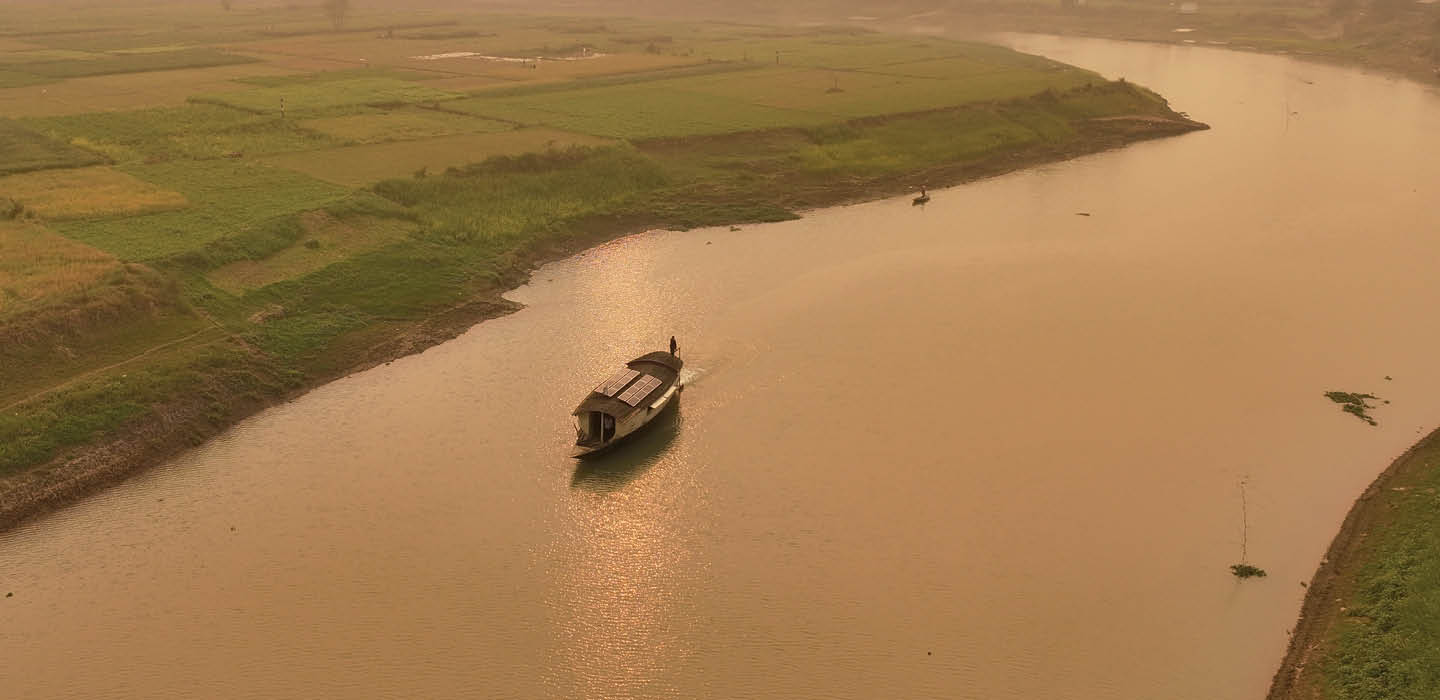

A small river boat with solar panels travels along a winding river beside farmland

Sheikh Shamim Somudro/Shidhulai Swanirvar Sangstha 

Standards

What If This Were Your School?

For years, huge floods in Bangladesh made it impossible for many kids to get to school. Then one of those kids grew up and wondered, What if the classroom came to them?  

Before You Read: Check out our Background Builder slideshow


Mohammed Rezwan/Shidhulai Swanirvar Sangstha

Amina* at her school

    From November to March, Amina’s* village is lush and peaceful. Long vines curl around one-story homes. Bright-green rice fields and dirt roads stretch as far as the eye can see. The nearby river is slow and calm.  

    But in the rainy season, much of this same village disappears. The fields and roads flood. The river makes an angry roar. Amina’s house is surrounded by water—like a little island in an endless sea.

    This doesn’t stop Amina. She steps out into knee-deep water. She walks carefully to the riverbank. Soon a long covered boat pulls up. Amina and a few other kids climb aboard.

    They’re not heading out on a trip. In fact, they’re not really going anywhere. This boat is their school. The inside of the boat looks like a normal classroom. There are wooden desks and benches. There are shelves packed with books and computers. A teacher stands in front of a blackboard. 

    This floating school allows Amina to keep learning as her world floods. “When everything is underwater, this school is our only hope,” Amina says.

    From November to March, Amina’s* village is lush and peaceful. Long vines curl around one-story homes. Rice fields and dirt roads stretch as far as the eye can see. The nearby river is calm.

    But in the rainy season, things change. The fields and roads flood. The river roars. Amina’s house is surrounded by water—like a little island.

    This doesn’t stop Amina. She steps out into knee-deep water. She walks to the riverbank. A boat pulls up. Amina and a few other kids climb aboard.

    They’re not heading out on a trip. In fact, they’re not going anywhere. This boat is their school. The inside of the boat looks like a normal classroom. There are wooden desks and benches. There are shelves packed with books and computers. A teacher stands in front of a blackboard.

    This floating school allows Amina to keep learning as her world floods. “When everything is underwater, this school is our only hope,” Amina says.

    From November to March, Amina’s* village is lush and peaceful. Long vines curl around one-story homes. Bright-green rice fields and dirt roads stretch as far as the eye can see. The nearby river is slow and calm.

    But during the rainy season, much of this same village disappears. The fields and roads flood. The river makes an angry roar. Amina’s house is surrounded by water—like a little island in an endless sea.

    This doesn’t stop Amina. She steps out into knee-deep water and walks carefully to the riverbank. Soon a long covered boat pulls up. Amina and a few other kids climb aboard.

    They aren’t heading out on a voyage—in fact, they’re not really going anywhere. This boat is their school. The inside of the boat looks like an ordinary classroom, with wooden desks, benches, and shelves packed with books and computers. A teacher stands in front of a blackboard.

    This floating school allows Amina to keep learning as her world floods. “When everything is underwater, this sc

Slowly Drowning

Jim McMahon/Mapman ® 

Flooding in Bangladesh
Bangladesh has always flooded because of its location. The country is on low-lying land where two rivers split into many branches. During the rainy season, rivers and streams overflow.

    Amina’s floating school is one of dozens across Bangladesh. That’s a country in South Asia. The idea for the schools was dreamed up by a man named Mohammed Rezwan. Like Amina, he grew up experiencing flooding in northwestern Bangladesh. 

    Bangladesh has always flooded. Most of the country lies barely above sea level. From June to October, the region gets hit by heavy rainstorms called monsoons.

    But experts agree that climate change has made the situation worse. Glaciers in areas to the north of Bangladesh are melting. This sends excess water into the country’s rivers and streams. 

    At the same time, sea levels are rising to the south of the country in the Indian Ocean. Monsoon rains are also becoming heavier.

    The result is that Bangladesh is slowly drowning. One-fifth of the country floods each year during monsoon season. In bad years, as much as two-thirds of the country floods. Hundreds of thousands of homes and buildings are damaged or destroyed. Roads wash out and travel is possible only by boat.

    Some scientists even say that 17 percent of the country could be underwater by 2050—for good. Losing that much land to flooding would leave 20 million people homeless.

    Amina’s floating school is one of dozens across Bangladesh. That’s a country in South Asia. The idea for the schools came from a man named Mohammed Rezwan. Like Amina, he grew up in Bangladesh. Like Amina, he lived through many floods.

    Bangladesh has always flooded. Most of the country lies barely above sea level. From June to October, the region gets hit by heavy rainstorms called monsoons.

    But experts say climate change has made the flooding worse. Glaciers in areas north of Bangladesh are melting. This sends excess water into rivers and streams.

    At the same time, sea levels are rising to the south of the country in the Indian Ocean. Monsoon rains are also getting heavier.

    The result is that Bangladesh is slowly drowning. One-fifth of the country floods each year during monsoon season. In bad years, as much as two-thirds of the country floods. Hundreds of thousands of homes and buildings are damaged or destroyed. Roads wash out. Only people with boats can travel.

    Some experts say that 17 percent of the country could be underwater by 2050—for good. Losing that much land to flooding would leave 20 million people homeless.

    Amina’s floating school is one of dozens across Bangladesh, a country in South Asia. The idea for the schools was dreamed up by a man named Mohammed Rezwan. Like Amina, Rezwan grew up experiencing flooding in northwestern Bangladesh.

    Bangladesh has always flooded. Most of the country lies barely above sea level. From June to October, the region gets pummeled by heavy rainstorms called monsoons.

    But experts agree that climate change has made the situation worse. Glaciers in areas to the north of Bangladesh are melting, sending excess water into the country’s rivers and streams.

    At the same time, sea levels are rising to the south of the country in the Indian Ocean. Monsoon rains are also becoming heavier.

    The result is that Bangladesh is slowly drowning. One-fifth of the country floods each year during monsoon season. In particularly bad years, as much as two-thirds of the country floods. Hundreds of thousands of homes and buildings are damaged or destroyed. Roads wash out and travel is possible only by boat.

    Some scientists even say that 17 percent of the country could be permanently underwater by 2050. Losing that much land to flooding would leave 20 million people homeless.

Sheikh Shamim Somudro/Shidhulai Swanirvar Sangstha 

Johan Bjerke/47 Million Children’s World’s Children’s Prize/www.worldschildrensprize.org

A Big Dream
Mohammed Rezwan (circled) had the idea for floating schools more than 25 years ago. Now there are dozens of boat schools in Bangladesh.

Floating Schools

Sheikh Shamim Somudro/Shidhulai Swanirvar Sangstha 

    Rezwan remembers the flooding in his childhood village. Farmers could not grow anything. Flooded roads made it impossible for most kids to travel to school.

    He was lucky: His family had a small boat. He used it to get to class. But he felt horrible for his friends who were left behind. “If children cannot go to school, can we bring the school to them?” he remembers thinking. 

    This question stuck with Rezwan. He went away to study architecture in college. But every time he visited home, he saw friends affected by the flooding. Some had been forced to quit school. Others couldn’t find jobs or get good health care.

    Rezwan decided he wanted to solve this problem. He knew that in some parts of the country, there were gardens and markets that floated on water. Soon the idea struck him: Why not floating schools? Floating libraries? Floating health clinics?

    Rezwan remembers the flooding in his childhood village. Farmers could not grow anything. Flooded roads kept most kids from getting to school.

    He was lucky: His family had a boat. He used it to get to class. But he felt sad for his friends who were left behind. “If children cannot go to school, can we bring the school to them?” he thought.

    Rezwan went away to study architecture in college. But every time he visited home, he saw friends affected by the flooding. Some had been forced to quit school. Others couldn’t find jobs or get good health care.

    Rezwan wanted to solve this problem. In some parts of the country, there were gardens and markets that floated on water. He got an idea: Why not floating schools? Floating libraries? Floating health clinics?

    Rezwan remembers how the flooding in his childhood village interfered with farming and prevented students from traveling to school.

    Fortunately for Rezwan, his family owned a small boat, which he was able to use to get to class. But he felt horrible for his friends who didn’t have the same opportunities. “If children cannot go to school, can we bring the school to them?” he recalls wondering.

    This question remained on Rezwan’s mind. He went away to study architecture in college—but every time he visited home, he saw friends whose lives were negatively affected by the flooding. Some had been forced to quit school. Others couldn’t find employment or get good health care.

    Rezwan decided he wanted to solve this problem. He knew that in some parts of the country, there were gardens and markets that floated on water. Before long, the idea struck him: Why not floating schools? Floating libraries? Floating health clinics?

By the People 

Sheikh Shamim Somudro/Shidhulai Swanirvar Sangstha 

    After college, Rezwan got to work. He collected scrap metal and plastic and sold it to factories. He used the money to pay for his idea.

    Finally, in 2002, Rezwan and his small team were able to complete their first boat school. Rezwan remembers standing on the deck of the finished boat and thinking, This is going to change the country.

    At first, however, people were skeptical. No one had heard of a floating school before. On day one, only one student came. But interest quickly grew. “Within a week, seven came. Within a month, 30,” Rezwan says. 

    Soon people in other villages began asking for boat schools. Volunteers stepped up to help build them. That’s why Rezwan says that the work his team does is “not just for the people, it is by the people.”

    After college, Rezwan got to work. He collected scrap metal and plastic and sold it to factories. He used the money for his idea.

    In 2002, Rezwan and his team finished building their first boat school. Rezwan thought, This is going to change the country.

    At first, people were skeptical. No one had heard of a floating school before. On day one, only one student came. But interest grew. It didn’t take long. “Within a week, seven came. Within a month, 30,” Rezwan says.

    Soon people in other villages asked for boat schools. Volunteers helped build them. That’s why Rezwan says that the work his team does is “not just for the people, it is by the people.”

    After college, Rezwan got to work. He collected scrap metal and plastic, sold it to factories, and used the money to fund his project.

    Finally, in 2002, Rezwan and his small team completed their first boat school. Rezwan remembers standing on the deck of the finished boat and thinking, This is going to change the country.

    Initially, however, people were skeptical. No one had heard of a floating school before. On day one, only one student showed up. But interest quickly increased. “Within a week, seven came. Within a month, 30,” Rezwan says.

    Soon people in other villages began asking for boat schools. Volunteers stepped up to help construct them. That’s why Rezwan says that the work his team does is “not just for the people, it is by the people.”

“To Our Doorstep” 

Mohammed Rezwan

    Now more than 22,500 students have been educated in Rezwan’s schools—students like Amina. “We don’t worry about safety or long walks for Amina,” says Amina’s mom, Rahima.* “The school comes to our doorstep.”

    Once all 30 students are on board, the boat docks. The school day begins. Amina sits beside her best friend, Salma.* They whisper quietly to each other and share notes on their lessons.

    Amina especially loves working on the school’s computer. It is powered by energy from the sun. Most people in the area do not have internet at home. So this computer gives students like Amina access to a world beyond their own.

    Now more than 22,500 students have gone to Rezwan’s schools—students like Amina. “We don’t worry about safety or long walks for Amina,” says Amina’s mom. “The school comes to our doorstep.”

    Once all 30 students are on board, the boat docks. The school day begins. Amina sits with her best friend. They study together.

    Amina loves using the school’s computer. It’s powered by energy from the sun. Most people in the area don’t have internet at home. This computer gives students like Amina access to a world beyond their own.

    Now more than 22,500 students have been educated in Rezwan’s schools—students like Amina. “We don’t worry about safety or long walks for Amina,” says Amina’s mother, Rahima.* “The school comes to our doorstep.”

    Once all 30 students are on board, the boat docks and the school day begins. Amina and her best friend, Salma,* sit together,  talking quietly and sharing notes on their lessons.

    Amina especially enjoys working on the school’s computer, which is powered by solar energy. Most people in the area don’t have internet at home, so this computer gives students like Amina access to a world beyond their own.


Keeping Hope Afloat

How Mohammed Rezwan and his team are changing lives in Bangladesh

Education

Floating schools allow kids to continue learning, even during floods.

Education

Floating schools allow kids to continue learning, even during floods.

Education

Floating schools allow kids to continue learning, even during floods.

Sheikh Shamim Somudro/Shidhulai Swanirvar Sangstha 

Health care

Six floating health clinics bring doctors to places that don’t have them.

Health care

Six floating health clinics bring doctors to places that don’t have them.

Health care

Six floating health clinics bring doctors to places that don’t have them.

Sheikh Shamim Somudro/Shidhulai Swanirvar Sangstha 

Internet

Floating libraries provide computers and internet service in flooded areas.

Internet

Floating libraries provide computers and internet service in flooded areas.

Internet

Floating libraries provide computers and internet service in flooded areas.

Sheikh Shamim Somudro/Shidhulai Swanirvar Sangstha 

Looking Ahead 

    The boat schools have been a big success. At many regular schools in Bangladesh, kids can’t attend class for much of the year. About half of those students end up dropping out. But at floating schools, almost every student graduates.

    Now Rezwan is trying to meet other needs. His team has built six floating health clinics. They’ve also built floating gardens, playground boats, and library boats.

    Then there are the floating training centers for adults. Rahima has been taking farming classes. “Now we grow crops and vegetables in better ways,” she says.

    This work has earned Rezwan many honors over the years. But he refuses to rest. He’s always looking for solutions to the world’s problems. 

    And he hopes young people will join him. “Always try to help others,” he says. “That is, I think, the purpose of life.”

    It’s a lesson that Amina has taken to heart. “I want to become a doctor,” she says. “I want to make sure our poor people can get treatment.” 

    Rezwan’s floating school has helped make that dream possible. “Before, I could have never imagined such a future,” Amina says. “Now, I can.” 

    The boat schools are a success. At many regular schools in Bangladesh, kids can’t go to class for much of the year. About half of those students drop out. But at floating schools, almost every student graduates.

    Now Rezwan wants to meet other needs. His team has built floating health clinics. They’ve built floating gardens. They’ve built  playground boats and library boats.

    Then there are the floating training centers for adults. Amina’s mom has been taking farming classes. “Now we grow crops and vegetables in better ways,” she says.

    This work has earned Rezwan many honors. But he isn’t finished. He’s always looking for ways to solve problems.

    And he hopes young people will join him. “Always try to help others,” he says. “That is, I think, the purpose of life.”

    Amina agrees. “I want to become a doctor,” she says. “I want to make sure our poor people can get treatment.”

    Her dream might come true. And she has her floating school to thank. “Before, I could have never imagined such a future,” Amina says. “Now, I can.” 

    The boat schools have been a tremendous success. At many regular schools in Bangladesh, kids can’t attend class for much of the year. About half of those students end up dropping out. But at floating schools, almost every student graduates.

    Now Rezwan is trying to meet other needs. His team has built six floating health clinics. They’ve also built floating gardens, playground boats, and library boats.

    Then there are the floating training centers for adults. Rahima has been taking farming classes. “Now we grow crops and vegetables in better ways,” she says.

    This work has earned Rezwan numerous honors over the years—but he refuses to rest. He’s always looking for solutions to the world’s problems.

    And he hopes young people will join him. “Always try to help others,” he says. “That is, I think, the purpose of life.”

    It’s a lesson that Amina has taken to heart. “I want to become a doctor,” she says. “I want to make sure our poor people can get treatment.”

    Rezwan’s floating school has been instrumental in making that dream possible. “Before, I could have never imagined such a future,” Amina says. “Now, I can.” 

*Names have been changed to protect the family’s privacy.

*Names have been changed to protect the family’s privacy.

*Names have been changed to protect the family’s privacy.

Background Builder

videos (1)
Skills Sheets (9)
Skills Sheets (9)
Skills Sheets (9)
Skills Sheets (9)
Skills Sheets (9)
Skills Sheets (9)
Skills Sheets (9)
Skills Sheets (9)
Skills Sheets (9)
Lesson Plan (1)
Leveled Articles (2)
Text-to-Speech