

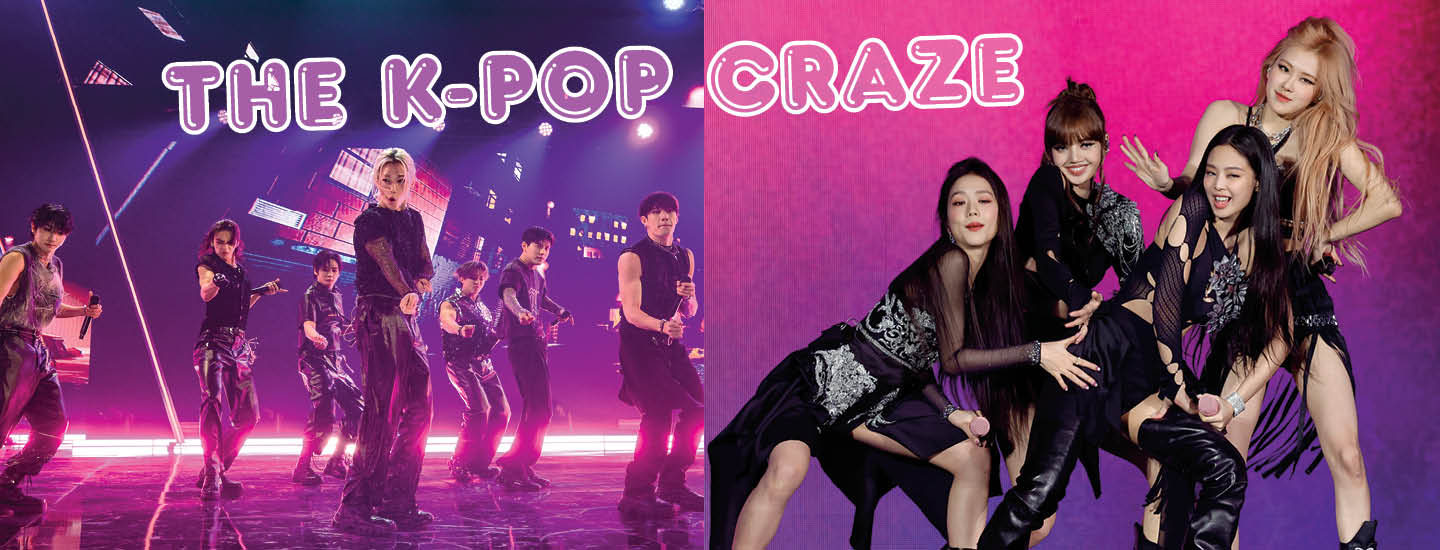

Two K-pop groups pose and perform on a stage under the title The K-Pop Craze

Michael Buckner/Penske Media via Getty Images (Stray Kids); Frazer Harrison/Getty Images for Coachella (BLACKPINK)

Standards

The K-Pop Craze

How music and culture from South Korea took over the world  

COLLECTION CHRISTOPHEL © Netflix - Columbia Pictures - Sony Pictures Animation - Sony Pictures Releasing/Alamy Stock Photo 

Saja Boys from KPop Demon Hunters

    Last summer, Cami found her new obsession. As soon as the 12-year-old from Ohio saw KPop Demon Hunters, she was hooked. She quickly learned all the words to the movie’s hit songs. She dressed up as Rumi, the main character, for Halloween. And she started listening to more K-pop music. 

    Cami is not alone. KPop Demon Hunters has become the most watched movie in the history of Netflix. “Golden,” the movie’s biggest song, was streamed more than 2.4 billion times last year. And Korean boy bands and girl groups attract screaming crowds wherever they go.

    How did pop music from South Korea take over the world?

    Cami is 12 years old. She lives in Ohio. Last summer, she saw KPop Demon Hunters. She was hooked. She learned the words to the movie’s songs. She dressed up as Rumi, the main character, for Halloween. And she started listening to more K-pop music.

    Cami is not alone. KPop Demon Hunters is the most watched movie in the history of Netflix. “Golden” is the movie’s biggest song. It has been streamed more than 2.4 billion times. And Korean boy bands and girl groups draw screaming crowds wherever they go.

    How did pop music from South Korea take over the world?

    Last summer, Cami found her new obsession. As soon as the 12-year-old from Ohio saw KPop Demon Hunters, she was hooked. She quickly learned all the words to the movie’s hit songs. She dressed up as Rumi, the main character, for Halloween. And she started listening to more K-pop music.

    Cami is not alone. KPop Demon Hunters has become the most watched movie in the history of Netflix, and “Golden,” the movie’s biggest song, was streamed more than 2.4 billion times last year. Screaming crowds form around Korean boy bands and girl groups wherever they go.

    How did pop music from South Korea take over the world?

What Is K-Pop?

TED ALJIBE/AFP via Getty Images 

    It might seem like the K-pop craze came out of nowhere. But South Korean pop culture has been getting more popular for years. There’s a word for it in Korean: hallyu, or “Korean Wave.”

    South Korea is a country in East Asia. For many years, its government allowed its people very little cultural freedom. Pop culture and music were often censored. That means that officials often shut down or banned things the government did not like.

    But in the late 1980s and 1990s, that changed. A new government came to power. That government saw globalization—or sharing between cultures—as a good thing. 

    That’s when Seo Taiji and Boys came on the scene. The boy band performed on a South Korean talent show in 1992. The judges didn’t get the band members’ trendy American-inspired style and hip-hop dance moves. They gave the band the lowest score of the night. 

    But people loved it. The band’s song topped the charts for weeks—and K-pop was born.

    The K-pop craze might seem new. But South Korean pop culture has been getting more popular for years. Koreans have a word for it: hallyu. That means “Korean Wave.”

    South Korea is a country in East Asia. For many years, people there had little cultural freedom. Pop culture and music were often censored. That means that officials shut down or banned things the government did not like.

    But in the late 1980s and 1990s, that changed. A new government came to power. That government saw globalization as a good thing. Globalization is sharing between cultures.

    Seo Taiji and Boys are a boy band. In 1992, they performed on a South Korean talent show. They had a trendy American style. They did hip-hop dance moves. The judges didn’t get it. The band got the lowest score of the night.

    But people loved it. The band’s song topped the charts for weeks. And K-pop was born.

    It might seem like the K-pop craze came out of nowhere, but South Korean pop culture has been gaining popularity for years. There’s a word for it in Korean: hallyu, or “Korean Wave.”

    South Korea is a country in East Asia. For many years, its government allowed its people very little cultural freedom. Pop culture and music were often censored. That means that officials often shut down or banned things the government did not like.

    But in the late 1980s and 1990s, that changed. A new government came to power, and that government viewed globalization—or sharing between cultures—as a good thing.

    That’s when Seo Taiji and Boys, a boy band, came on the scene. They performed on a South Korean talent show in 1992. The judges didn’t appreciate the band members’ trendy American-inspired style and hip-hop dance moves, so they gave the band the lowest score of the night. 

    However, the audience loved it. The band’s song topped the charts for weeks—and K-pop was born.

The Idol System

Jim McMahon/Mapman ® 

    Over the next 10 years, a new system formed in South Korea. Its goal was to train young Korean artists to be the next big stars. In South Korea, they’re known as idols. That system is still in place today. 

    Imagine you’re a young singer from South Korea. Before you’re even a teen, you’re trying out for K-pop entertainment companies. If you’re lucky, you get hired as a trainee. That means you’re in training to become an idol. 

    As a trainee, you take singing and dancing lessons. You learn English. You practice being interviewed. You learn how to present yourself. 

    If you’re lucky, you’ll get to debut as an idol. Most idols are put into groups with other young artists.

    Over the next 10 years, a new system formed in South Korea. It trains young Korean artists to be the next big stars. In South Korea, they’re known as idols. That system is still in place today.

    Imagine you’re a young singer from South Korea. You’re not even a teen. But you’re trying out for K-pop entertainment companies. If you’re lucky, you get hired as a trainee. That means you train to become an idol.

    As a trainee, you take singing and dancing lessons. You learn English. You practice being interviewed. You learn how to present yourself.

    If you’re lucky again, you debut as an idol. Most idols are put into groups with other young artists.

    Over the next 10 years, a new system formed in South Korea. Its goal was to train young Korean artists to be the next big stars. In South Korea, they’re known as idols. That system is still in place today.

    Imagine you’re a young singer from South Korea. Before you’re even a teen, you’re auditioning for K-pop entertainment companies. If you’re lucky, you get hired as a trainee—which means you’re in training to become an idol.

    As a trainee, you take singing and dancing lessons, learn English, practice being interviewed, and learn how to present yourself.

    If you’re lucky, you’ll get to debut as an idol. Most idols are put into groups with other young artists.


Where in the World

South Korea

Shutterstock.com

Korea was once one country. After World War II, it was split into two: North Korea and South Korea. Seoul (pictured here) is South Korea’s capital and biggest city.

Korea was once one country. After World War II, it was split into two: North Korea and South Korea. Seoul (pictured here) is South Korea’s capital and biggest city.

Korea was once one country. After World War II, it was split into two: North Korea and South Korea. Seoul (pictured here) is South Korea’s capital and biggest city.

Going Global

    There have always been K-pop fans in the U.S.—and around the world. But K-pop was not big outside South Korea and Japan until the 2010s. That’s when social media made it easier to discover pop culture from other countries. 

    In 2012, Korean artist Psy released the song “Gangnam Style.” The video for the song went viral. It became the first video on YouTube to pass 1 billion streams. Suddenly, the world was waking up to K-pop’s catchy tunes. 

    The next year, BTS put out its first music. The group’s songs touched on topics like self-love and bullying. BTS became famous for its emotional lyrics and huge army of fans. Blackpink, Stray Kids, and many other groups followed.

    And then came KPop Demon Hunters. 

    The movie is about a K-pop girl group called Huntr/x that secretly fights evil spirits. It was an unexpected hit. And it introduced people to even more aspects of South Korean culture. 

    But maybe the coolest thing about KPop Demon Hunters? It was created by a Korean Canadian woman. It was made by an American movie studio. Yet it’s all about Korean culture.

     Just like K-pop, it’s a truly global phenomenon. 

    K-pop has always had fans in the U.S. and around the world. But it wasn’t big outside South Korea and Japan until the 2010s. That’s when social media made it easier to discover pop culture from other countries. 

    In 2012, Korean artist Psy released the song “Gangnam Style.” The song had a video. It went viral. It was the first video on YouTube to pass 1 billion streams.

    The next year, BTS put out its first music. The group sang about self-love, bullying, and other topics. BTS became famous for its huge army of fans. Blackpink, Stray Kids, and many other groups followed.

    And then came KPop Demon Hunters.

    The movie is about a K-pop girl group. They’re called Huntr/x. They secretly fight evil spirits. It was an unexpected hit. It helped people learn more about South Korean culture.

    But maybe the coolest thing about the movie? It was created by a Korean Canadian woman. It was made by an American movie studio. Yet it’s all about Korean culture.

    Like K-pop, it’s a global phenomenon. 

    There have always been K-pop fans in the U.S.—and around the world. But K-pop wasn’t big outside South Korea and Japan until the 2010s, when social media made it easier to discover pop culture from other countries.

    In 2012, Korean artist Psy released the song “Gangnam Style.” The video for the song went viral, becoming the first video on YouTube to pass 1 billion streams. Suddenly, the world was waking up to K-pop’s catchy tunes.

    The following year, BTS put out its first music. The group’s songs touched on topics like self-love and bullying, and BTS became famous for its emotional lyrics as well as its massive army of fans. Blackpink, Stray Kids, and many other groups followed.

    And then came KPop Demon Hunters.

    The movie is about a K-pop girl group called Huntr/x that secretly fights evil spirits. It was an unexpected hit, and it introduced people to even more aspects of South Korean culture.

    But maybe the coolest thing about KPop Demon Hunters? It was created by a Korean Canadian woman and made by an American movie studio, yet it’s all about Korean culture.

     Just like K-pop, it’s a truly global phenomenon. 


The K-Wave

K-pop has fueled an interest in other parts of Korean culture.

Language: Duolingo is a language app. It saw a 22 percent increase in people learning Korean last year!

Language: Duolingo is a language app. It saw a 22 percent increase in people learning Korean last year!

Language: Duolingo is a language app. It saw a 22 percent increase in people learning Korean last year!

Shutterstock.com 

Food: Kimbap is a popular Korean dish. It’s made of rice and other fillings wrapped in seaweed. In 2023, TikTok videos of the tasty treat caused grocery stores in the U.S. to sell out of it.

Food: Kimbap is a popular Korean dish. It’s made of rice and other fillings wrapped in seaweed. In 2023, TikTok videos of the tasty treat caused grocery stores in the U.S. to sell out of it.

Food: Kimbap is a popular Korean dish. It’s made of rice and other fillings wrapped in seaweed. In 2023, TikTok videos of the tasty treat caused grocery stores in the U.S. to sell out of it.

Shutterstock.com 

TV: South Korean series like Squid Game and Extraordinary Attorney Woo are popular on Netflix.

TV: South Korean series like Squid Game and Extraordinary Attorney Woo are popular on Netflix.

TV: South Korean series like Squid Game and Extraordinary Attorney Woo are popular on Netflix.

Shutterstock.com 


Pop Stars and Evil Spirits

KPop Demon Hunters creator Maggie Kang was excited to share her Korean culture with the world. So she got to work “making the most Korean movie I could make,” Kang says. She combined K-pop with aspects of Korean art, mythology, and folklore. Here are just a few examples.  

Huntr/x

Plan Shooting2/ImaZinS RF/Getty Images

Kang was inspired by a religion called Korean shamanism. In ancient Korea, mudangs were women who drove away dark spirits. The mudangs often sang and danced to scare the evil away—just like Huntr/x.

Kang was inspired by a religion called Korean shamanism. In ancient Korea, mudangs were women who drove away dark spirits. They did this by singing and dancing—just like Huntr/x.

Kang was inspired by a religion called Korean shamanism. In ancient Korea, mudangs were women who drove away dark spirits. The mudangs often sang and danced to scare the evil away—just like Huntr/x.

BFA/Netflix/Alamy Stock Photo

Their special blades are modeled after ancient Korean weapons!

The Demons

Shutterstock.com 

Some of the movie’s demons look like ogres or goblins. These were modeled after spirits called dokkaebi. In Korean folklore, dokkaebi aren’t always evil. (But they are hard to predict!)

Some of the movie’s demons look like ogres or goblins. They were modeled after spirits called dokkaebi. In Korean folklore, dokkaebi aren’t always evil. (But they are hard to predict!)

Some of the movie’s demons look like ogres or goblins. These were modeled after spirits called dokkaebi. In Korean folklore, dokkaebi aren’t always evil—but they are hard to predict! 

TCD/Prod DB © Netflix - Columbia Pictures - Sony Pictures Animation - Sony Pictures Releasing/Alamy Stock Photo

Derpy and Sussie

Shutterstock.com 

In Korean folklore and art, the tiger and the magpie (a kind of bird) are often shown together. The tiger is a symbol of protection and is believed to drive away evil spirits. The magpie is a sign of good luck and often brings good news.

In Korean folklore and art, the tiger is often shown with the magpie. (That’s a type of bird.) The tiger stands for protection. It’s believed to drive away evil spirits. The magpie is a sign of good luck. It often brings good news.

In Korean folklore and art, the tiger and the magpie (a kind of bird) are often shown together. The tiger is a symbol of protection and is believed to drive away evil spirits, while the magpie is a sign of good luck and often brings good news.

Sony Pictures Releasing/Alamy Stock Photo (Demons); Ent-movie/Alamy Stock Photo

Skills Sheets (5)
Skills Sheets (5)
Skills Sheets (5)
Skills Sheets (5)
Skills Sheets (5)
Lesson Plan (1)
Leveled Articles (2)
Text-to-Speech