

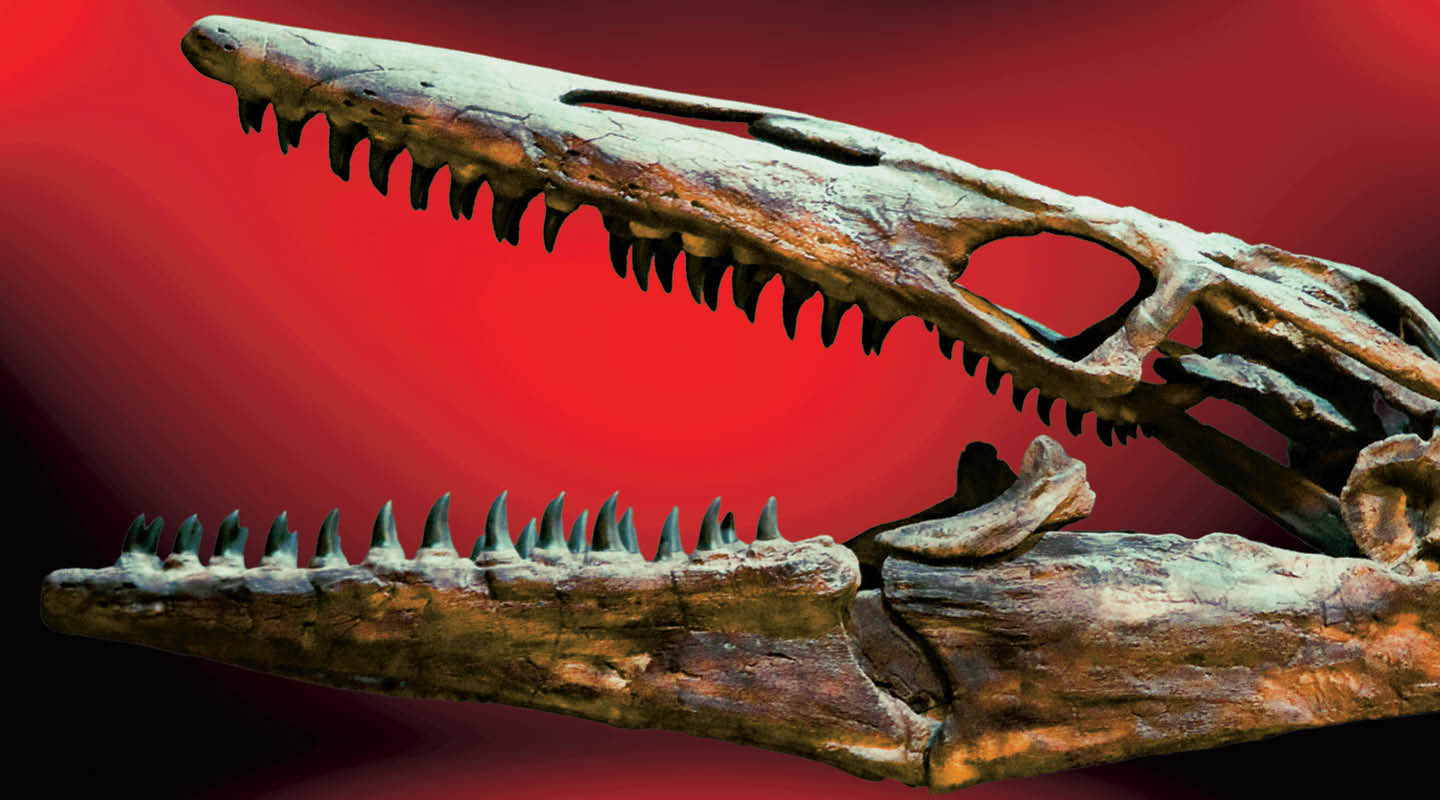

Michelle Crawford/Alamy Stock Photo (Skull); Shutterstock.com (Background)

Standards

The Bone Hunter

The story of the 12-year-old girl who helped discover the world of dinosaurs  

Before You Read: Check out our Background Builder slideshow


Mary Anning Illustration by Anthony VanArsdale

Mary Anning

    You swim in the blue-green waters of a shallow sea. The air above you is thick and heavy. The sun is scorching hot.

    Lizard-like creatures the size of small planes zip across the skies. Powerful sea beasts swim in the waters below. Yet you have no reason to be afraid. You are a monster too. 

    You are a mighty Ichthyosaurus (ik-thee-uh-SOR-uhs). You lived in the ocean millions of years ago. You’re gigantic, with eyes the size of tennis balls. Few creatures can match your speed.

    But like all living things, you eventually die. You fall to the bottom of the sea. Over millions of years, your flesh rots and your bones turn into rock. All that remains of you is a fossil. Your watery home becomes dry land. 

    You are forgotten.

    Until one day, a 12-year-old girl on a windy beach digs you up. Her name is Mary Anning. Together, you will change the world.

    You swim in the blue-green waters of a shallow sea. The air above you is thick and heavy. The sun is hot.

    Lizard-like creatures the size of small planes zip across the skies. Powerful sea beasts swim in the waters below. But you are not afraid. You are a monster too.

    You are an Ichthyosaurus (ik-thee-uh-SOR-uhs). You lived in the ocean millions of years ago. You’re huge, with eyes the size of tennis balls. Few creatures can match your speed.

    But like all living things, you die one day. You fall to the bottom of the sea. Over many years, your flesh rots and your bones turn into rock. All that remains of you is a fossil. Your watery home becomes dry land.

    You are forgotten.

    Until one day, a 12-year-old girl on a windy beach digs you up. Her name is Mary Anning. Together, you will change the world.

    You swim in the blue-green waters of a shallow sea. The air above you is thick and heavy, the sun scorching hot.

    Lizard-like creatures the size of small planes zip across the skies, and powerful sea beasts swim in the waters below. Yet you have nothing to fear—after all, you are a monster too.

    You are a mighty Ichthyosaurus (ik-thee-uh-SOR-uhs). You lived in the ocean millions of years ago. You’re gigantic, with eyes the size of tennis balls. Few creatures can match your speed.

    But like all living things, you eventually die. You fall to the bottom of the sea. Over millions of years, your flesh rots and your bones are transformed into rock. All that remains of you is a fossil. Your watery home becomes dry land.

    You are forgotten.

    Until one day, a 12-year-old girl on a windy beach digs you up. Her name is Mary Anning. Together, you will change the world.

Shells and Rocks

    Mary Anning was born in 1799. She grew up in the tiny seaside town of Lyme Regis, England. Mary loved to spend hours walking with her dad along the beach near their house. This area was famous for its peculiar shells and rocks. Mary and her dad would gather them and sell them.

    Then something terrible happened: When Mary was about 11, her dad died. The family was left with little money. Mary wanted to help. So she kept walking the beach, searching for shells and rocks to sell. 

    Soon she found something more than shells and rocks though. And what she found wouldn’t help just her family.

    It would change the way people understood ancient creatures too.

    Mary Anning was born in 1799. She grew up in the town of Lyme Regis, England. Mary loved to walk with her dad along the beach near their house. This area was famous for its peculiar shells and rocks. Mary and her dad would gather them and sell them.

    Then something terrible happened: When Mary was about 11, her dad died. The family was left with little money. Mary wanted to help. So she kept walking the beach, looking for shells and rocks to sell.

    Soon she found something more than shells and rocks though. And what she found wouldn’t just help her family.

    It would change the way people understood ancient creatures too.

    Mary Anning was born in 1799 and grew up in the tiny seaside town of Lyme Regis, England. Mary loved to spend hours walking with her father along the beach near their house. The area was famous for its peculiar shells and rocks, and Mary and her dad would gather them and sell them.

    Then something terrible happened: When Mary was about 11, her father died. The family was left with little money. Mary wanted to help, so she kept walking the beach in search of shells and rocks to sell.

    Soon she found something more than shells and rocks though—and what she discovered wouldn’t only help her family.

    It would also change the way people understood ancient creatures.


Build Knowledge

Earth: A Brief History

DEA/A. DAGLI ORTI/De Agostini via Getty Images (Skull); Shutterstock.com (All Other Images)

A- Dinosaurs Rule

Dinosaurs first appeared about 245 million years ago. They ruled the planet during a time known as the Mesozoic Era.


B- An Asteroid Hits  

A giant space rock called an asteroid struck Earth about 66 million years ago. Over time, this caused all dinosaurs to become extinct, or die out.


C- Hello, Humans  

The first humans appeared on Earth somewhere between 2 million and 6 million years ago.


D- Today  

Scientists continue to learn about prehistoric Earth by studying fossils.

A- Dinosaurs Rule

Dinosaurs first appeared about 245 million years ago. They ruled the planet during a time known as the Mesozoic Era.


B- An Asteroid Hits  

A giant space rock called an asteroid struck Earth about 66 million years ago. Over time, this caused all dinosaurs to become extinct, or die out.


C- Hello, Humans  

The first humans appeared on Earth somewhere between 2 million and 6 million years ago.


D- Today  

Scientists continue to learn about prehistoric Earth by studying fossils.

A- Dinosaurs Rule

Dinosaurs first appeared about 245 million years ago. They ruled the planet during a time known as the Mesozoic Era.


B- An Asteroid Hits  

A giant space rock called an asteroid struck Earth about 66 million years ago. Over time, this caused all dinosaurs to become extinct, or die out.


C- Hello, Humans  

The first humans appeared on Earth somewhere between 2 million and 6 million years ago.


D- Today  

Scientists continue to learn about prehistoric Earth by studying fossils.

Even More Fantastic

    Mary’s brother spotted it first. It looked like a huge skull buried in the sand. One giant eye peeked out. 

    But it was Mary who found the rest. For months, Mary returned to the beach. Slowly, she chipped away at the rock surrounding the skeleton. 

    Finally, Mary uncovered the full fossil. It was unlike anything anyone had ever seen before. Its body was like a lizard’s. But it also had flippers like a dolphin and a tail like a shark. It was 17 feet long. Several men had to help Mary carry it home.

    Mary quickly sold the skeleton. This earned her enough money to feed her family for months. The skeleton was put on display at a small museum in London. People were amazed. Mary’s discovery seemed like a monster from a storybook. 

    But as the world would learn, Mary’s creature came from a place even more fantastic. The animal was an ichthyosaur. It lived about 200 million years ago, during the Jurassic Period.

    This is when dinosaurs roamed the earth.

    Mary’s brother saw it first. It looked like a huge skull buried in the sand. One eye peeked out.

    Mary found the rest. For months, she returned to the beach. She chipped away at the rock surrounding the skeleton.

    Finally, she uncovered the full fossil. It was unlike anything anyone had ever seen before. Its body was like a lizard’s. But it had flippers like a dolphin and a tail like a shark. It was 17 feet long. Several men had to help Mary carry it home.

    Mary sold the skeleton. She got enough money to feed her family for months. The skeleton was put on display at a museum in London. People were amazed. The skeleton seemed like a monster from a storybook.

    But Mary’s creature came from a place even more fantastic. The animal was an ichthyosaur. It lived about 200 million years ago, during the Jurassic Period.

    This is when dinosaurs roamed Earth.

    Mary’s brother spotted it first. It appeared to be a massive skull buried in the sand, with one giant eye peeking out.

    But it was Mary who found the rest. She returned to the beach repeatedly, chipping away for months at the rock that surrounded the skeleton.

    Finally, Mary uncovered the entire fossil. It was unlike anything anyone had ever seen before. Its body was similar to a lizard’s, but it also had flippers like a dolphin and a tail like a shark. To carry the 17-foot-long fossil home, Mary needed the help of several men.

    Mary quickly sold the skeleton, which earned her enough money to feed her family for months. The skeleton was put on display at a museum in London. People were amazed by the discovery, which seemed like a monster from a storybook.

    But as the world would learn, Mary’s creature came from a place even more fantastic. The animal, an ichthyosaur, lived about 200 million years ago, during the Jurassic Period.

    This is when dinosaurs roamed Earth.

An Unknown World

    Imagine what it was like to see such a skeleton in 1811. No one had heard of dinosaurs. The word dinosaur didn’t even exist.

    Of course, people had found odd fossils before. They’d seen strange bones on cliffsides. Huge footprints had been found in rocks. But scientists back then believed that these fossils came from animals that still lived somewhere on Earth. 

    Mary’s skeleton was different. It did not look like any creature on Earth. To many scientists, it proved that animals could become extinct. 

    Mary’s discovery helped create paleontology. That’s the field of science that studies fossils. And soon it would change our view of Earth’s history. 

    Scientists began to wonder: What other large and mysterious creatures roamed our planet millions of years ago? And what else could we discover through fossils?

    Imagine seeing that skeleton in 1811. No one had heard of dinosaurs. The word dinosaur didn’t even exist.

    Of course, people had found odd fossils before. They’d seen strange bones on cliffsides. Huge footprints had been found in rocks. But scientists back then believed that these fossils came from animals that still lived somewhere on Earth.

    Mary’s skeleton was different. It did not look like any creature on Earth. To many scientists, it proved that animals could become extinct.

    Mary’s discovery helped create paleontology. That’s the field of science that studies fossils. And soon it would change our view of Earth’s history.

    Scientists began to wonder: What other mysterious creatures roamed Earth long ago? And what else could we learn from fossils?

    Imagine how astonishing it was to see such a skeleton in 1811. At the time, no one had heard of dinosaurs. The word dinosaur didn’t even exist.

    Of course, people had encountered odd fossils before. They’d noticed strange bones on cliffsides and found enormous footprints in rocks. But scientists back then believed that these fossils came from animals that still existed somewhere on Earth.

    Mary’s skeleton was different. It didn’t resemble any creature on Earth. In the minds of many scientists, it proved that animals could become extinct.

    Mary’s discovery helped create paleontology, the field of science that studies fossils—and soon it would transform our understanding of Earth’s history.

    Scientists began to wonder: What other large and mysterious creatures roamed our planet millions of years ago? And what else could we discover through fossils?

Trustees of the Natural History Museum, London (Ichthyosaur Fossil); Shutterstock.com (All Other Images)

Sea Monster
This image shows what an ichthyosaur may have looked like.

New Discoveries

    Mary continued to make important discoveries for the rest of her life. She found a fossil of a flying reptile called a Dimorphodon. She was the first to find a complete skeleton of a sea reptile called a Plesiosaurus. She even studied coprolite. That’s fossilized poop!

    So why isn’t Mary Anning as famous as Thomas Edison or other important scientists from history?

    The reason is this: Mary was a woman. At the time, women were kept out of colleges and high-level jobs. In Europe and the U.S., scientists were almost all rich men. Many of them met Mary. They praised her talents. But they did not ask her to join their scientific groups. 

    Some of the men even took credit for her work. Mary resented this. Still, she loved science. She kept working at it until she died at age 47.

    Mary made other big discoveries. She found a fossil of a flying reptile called a Dimorphodon. She was the first to find a complete skeleton of a sea reptile called a Plesiosaurus. She even studied coprolite. That’s fossilized poop!

    So why isn’t Mary Anning as famous as Thomas Edison or other important scientists from history?

    The reason is this: Mary was a woman. At the time, women were kept out of colleges and high-level jobs. In Europe and the U.S., most scientists were rich men. Many of them met Mary. They praised her talents. But they didn’t ask her to join their scientific groups.

    Some of the men took credit for her work. Mary resented this. But she loved science. She worked at it until she died at age 47.

    Mary continued to make important discoveries throughout her life. She found a fossil of a flying reptile called a Dimorphodon, and she was the first to find a complete skeleton of a sea reptile called a Plesiosaurus. She even studied coprolite—that’s fossilized poop!

    So why isn’t Mary Anning as renowned as Thomas Edison or other important scientists from history?

    The explanation is that Mary was a woman, and at that time, women weren’t offered opportunities to attend college or hold high-level jobs. Nearly all scientists in Europe and the United States were rich men—and while many of them met Mary and praised her talents, they didn’t invite her to join their scientific organizations.

    Some of the men even took credit for Mary’s work. Mary resented this, but she remained passionate about science and continued working at it until she died at age 47.

Where in the World: The Jurassic Coast

DEA/A. DAGLI ORTI/De Agostini via Getty Images (Skull); Shutterstock.com (All Other Images)

Today the beach where Mary once walked is part of the Jurassic Coast. This 95-mile stretch of coastline in southern England is known for its many fossils. Visitors still go on fossil hunts there today!

Today the beach where Mary once walked is part of the Jurassic Coast. This 95-mile stretch of coastline in southern England is known for its many fossils. Visitors still go on fossil hunts there today!

Today the beach where Mary once walked is part of the Jurassic Coast. This 95-mile stretch of coastline in southern England is known for its many fossils. Visitors still go on fossil hunts there today!

The Prehistoric World

Tommy Trenchard/Panos Pictures/Redux

Up Close
Visitors look at an Ichthyosaurus fossil at a museum. Studying fossils helps scientists understand how dinosaurs looked and behaved.

    Today we still know very little about the prehistoric world. Scientists continue to learn about dinosaurs. They are finding out what these incredible animals looked like and how they behaved. Each new discovery they make tells us more.

    And who knows? Right now, there is a kid walking on a beach somewhere. Maybe they’re about to make a major discovery. 

    And that discovery could change our ideas about the prehistoric Earth—just like Mary Anning’s did.

    Today we still know very little about the prehistoric world. Scientists continue to learn about dinosaurs. They are finding out what these incredible animals looked like and how they behaved. Each new discovery they make tells us more.

    And who knows? Right now, there is a kid walking on a beach somewhere. Maybe they’re about to make a big discovery.

    And that discovery could change our ideas about the prehistoric Earth—just like Mary Anning’s did. 

    Today we still know very little about the prehistoric world. Scientists continue to investigate the world of dinosaurs, finding out what these incredible animals looked like and how they behaved. Each new discovery they make tells us more.

    And who knows? Right now, maybe a kid walking on a beach somewhere is about to make a monumental discovery.

    And that new discovery could dramatically change our ideas about the prehistoric Earth—just like Mary Anning’s did. 

Text copyright ©Lauren Tarshis

Text copyright ©Lauren Tarshis

Text copyright ©Lauren Tarshis

ACTIVITY: 
Finding Text Evidence

You’ve just read “The Bone Hunter.” Now it’s time to do this activity

Tip: Text evidence means details in a story that support an answer or show that it is true.

What to do: Use text evidence—or details from the article—to answer the questions below. We did the first one for you.

You’ve just read “The Bone Hunter.” Now it’s time to do this activity

Tip: Text evidence means details in a story that support an answer or show that it is true.

What to do: Use text evidence—or details from the article—to answer the questions below. We did the first one for you.

You’ve just read “The Bone Hunter.” Now it’s time to do this activity

Tip: Text evidence means details in a story that support an answer or show that it is true.

What to do: Use text evidence—or details from the article—to answer the questions below. We did the first one for you.

When Mary Anning found the Ichthyosaurus skeleton, why was she searching the beach?

HINT: Look for the answer in the section “Shells and Rocks.”

Answer: Mary was searching for shells and rocks to sell because her family needed money.

When Mary Anning found the Ichthyosaurus skeleton, why was she searching the beach?

HINT: Look for the answer in the section “Shells and Rocks.”

Answer: Mary was searching for shells and rocks to sell because her family needed money.

When Mary Anning found the Ichthyosaurus skeleton, why was she searching the beach?

HINT: Look for the answer in the section “Shells and Rocks.”

Answer: Mary was searching for shells and rocks to sell because her family needed money.

How long did it take Mary to unearth the skeleton?

HINT: Look for the answer in the section “Even More Fantastic.”

How long did it take Mary to unearth the skeleton?

HINT: Look for the answer in the section “Even More Fantastic.”

How long did it take Mary to unearth the skeleton?

HINT: Look for the answer in the section “Even More Fantastic.”

Why was it difficult for Mary to become a well-known scientist?

HINT: Look for the answer in the section “New Discoveries.”

Why was it difficult for Mary to become a well-known scientist?

HINT: Look for the answer in the section “New Discoveries.”

Why was it difficult for Mary to become a well-known scientist?

HINT: Look for the answer in the section “New Discoveries.”

How did Mary respond when male scientists took credit for her work?

HINT: Look for the answer in the section “New Discoveries.”

How did Mary respond when male scientists took credit for her work?

HINT: Look for the answer in the section “New Discoveries.”

How did Mary respond when male scientists took credit for her work?

HINT: Look for the answer in the section “New Discoveries.”

Think About It! What do your answers tell you about Mary Anning’s personality?

Think About It! What do your answers tell you about Mary Anning’s personality?

Think About It! What do your answers tell you about Mary Anning’s personality?

Background Builder

videos (1)
Skills Sheets (9)
Skills Sheets (9)
Skills Sheets (9)
Skills Sheets (9)
Skills Sheets (9)
Skills Sheets (9)
Skills Sheets (9)
Skills Sheets (9)
Skills Sheets (9)
Lesson Plan (1)
Leveled Articles (2)
Text-to-Speech