

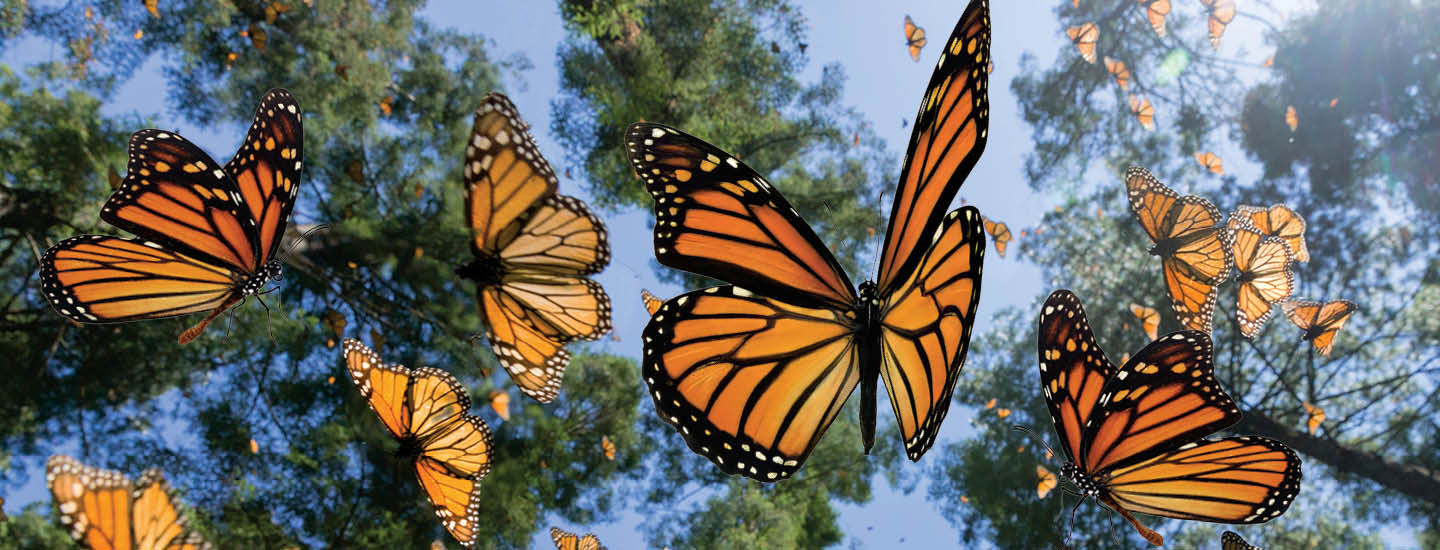

Sylvain Cordier/Biosphoto/Minden Pictures (Background, Tree); Shutterstock.com (Left & Right Butterflies)

Standards

Flight of the Monarchs

Every year, monarch butterflies fly thousands of miles to Mexico. Action writer Mary Kate Frank visited them there last year. Here’s what she learned about these beautiful creatures—and why they need our help.  

Courtesy of Mary Kate Frank

Mary Kate Frank

    It’s a cloudy February morning high in the mountains of central Mexico. A group of travelers stand still, staring up at fir trees.

    “Where?” someone whispers. “I don’t see anything.”

    The tree branches look heavy with dead leaves. Or so it seems. Then the sun shines. The leaves move.

    Those “leaves” are millions of sleeping monarch butterflies. Warmed by the sun, they come to life. A glittering orange storm swirls through the forest. The butterflies land on people’s arms, backs—even their heads! 

    Every year, millions of monarchs in the northern U.S. and Canada fly to Mexico. Some travel nearly 3,000 miles to escape winter. This migration is one of nature’s greatest journeys. But these butterflies could disappear.

    Eduardo Rendón-Salinas is a scientist at the World Wildlife Fund (WWF). He has studied monarchs in Mexico for 30 years. In that time, their numbers have fallen by about 70 percent. 

    “The monarchs are in real danger right now,” says Rendón-Salinas. “They face so many threats.”

    Can we save these special insects before it’s too late?

    It’s a cloudy February morning in the mountains of central Mexico. A group of travelers stand still. They stare up at fir trees.

    “Where?” someone asks. “I don’t see anything.”

    The tree branches look heavy with dead leaves. Then the sun shines. The leaves move.

    Those “leaves” are millions of sleeping monarch butterflies. Now the sun warms them. They wake up. A glittering orange storm swirls through the forest. The monarchs land on people’s arms, backs—even their heads!

    Every year, millions of monarchs leave the northern U.S. and Canada. They fly to Mexico. Some travel nearly 3,000 miles to escape winter. This migration is one of nature’s greatest journeys. But these butterflies could disappear.

    Eduardo Rendón-Salinas is a scientist at the World Wildlife Fund (WWF). He has studied monarchs in Mexico for 30 years. In that time, their numbers have fallen by about 70 percent.

    “The monarchs are in real danger right now,” he says. “They face so many threats.”

    Can we save them?

    It’s a cloudy February morning high in the mountains of central Mexico. A group of travelers stand still, staring up at fir trees.

    “Where?” someone whispers. “I don’t see anything.”

    The tree branches look heavy with dead leaves—or so it seems. Then the sun shines, and the leaves move.

    Those “leaves” are millions of sleeping monarch butterflies. Warmed by the sun, they come to life, and a glittering orange storm swirls through the forest. The butterflies land on people’s arms, backs—even their heads!

    Every year, millions of monarchs in the northern U.S. and Canada fly to Mexico, some traveling nearly 3,000 miles to escape winter. This migration is one of nature’s greatest journeys. But these butterflies could disappear.

    Eduardo Rendón-Salinas, a scientist at the World Wildlife Fund (WWF), has studied monarchs in Mexico for 30 years. In that time, their numbers have fallen by about 70 percent.

    “The monarchs are in real danger right now,” says Rendón-Salinas. “They face so many threats.”

    Can we save these fascinating insects before it’s too late?

An Incredible Journey 

Shutterstock.com 

Winter Rest
Monarchs cluster on fir trees in Mexico to keep warm.

    Monarchs start as caterpillars that hatch from eggs. Once they’re butterflies, most live only two to six weeks. But some belong to a monarch “super generation” born in late summer. These monarchs live for about eight months. This helps them make an incredible journey south.

    Let’s imagine that you’re one of those special monarchs. Your home is a patch of wildflowers in Pennsylvania. One day in September, you shiver. The air has turned cooler. You must head south to avoid freezing. 

    When you take flight, you know exactly where to go. It’s as if you hold a map in your mind. Your tiny wings carry you up to 100 miles a day. Along the way, you stop to sip nectar from flowers. You carry pollen from one flower to the next. This is part of your job in nature. It helps plants grow.

    After a few months, you reach a forest in Mexico. Finally! You spend all winter resting.

    In spring, you head north. As you travel, you breed. Somewhere in the southern United States, you die. 

    But don’t worry. 

    Your offspring—and their offspring and their offspring—continue the trip. It’s like an amazing monarch relay race!

    Monarchs start as caterpillars. They hatch from eggs. As butterflies, most live only two to six weeks. But some belong to a “super generation.” They are born in late summer. These monarchs live for about eight months. This helps them make the long trip south.

    Imagine this: You’re a super monarch. Your home is a patch of wildflowers in Pennsylvania. One day in September, you shiver. The air has turned cooler. You head south to avoid freezing.

    You know where to go. It’s as if you hold a map in your mind. Your tiny wings carry you up to 100 miles a day. Along the way, you stop. You sip nectar from flowers. You carry pollen from flower to flower. This helps plants grow.

    After a few months, you reach Mexico. You land in a forest there. You spend all winter resting.

    In spring, you head north. As you travel, you breed.

    Along the way, you die.

    But don’t worry.

    Your offspring—and their offspring and their offspring—continue the trip. It’s like a relay race!

    Monarchs start as caterpillars that hatch from eggs. Once they become butterflies, most live only two to six weeks. But some belong to a monarch “super generation” born in late summer, and these monarchs live for about eight months—which helps them make an incredible journey south.

    Let’s imagine that you’re one of those special monarchs. Your home is a patch of wildflowers in Pennsylvania. One day in September, you shiver. The air has turned cooler, so you must head south to avoid freezing.

    When you take flight, you know exactly where to go, as if you hold a map in your mind. Your tiny wings carry you up to 100 miles a day. Along the way, you stop to sip nectar from flowers, carrying pollen from one flower to the next. This activity, which helps plants grow, is part of your role in the natural world.

    After a few months, you reach a forest in Mexico. Finally! You spend all winter resting.

    In spring, you head north—and as you travel, you breed. Somewhere in the southern United States, you die.

    But don’t worry.

    Your offspring—and their offspring and their offspring—continue the trip. It’s like an amazing monarch relay race!

Facing Threats

Jim McMahon/Mapman ® 

Monarch Migration  
Most monarchs in North America fly to Mexico for the winter. Some travel to Florida or California. Future generations (their offspring, their offspring’s offspring, etc.) complete the trip back north in the spring.

    Sadly, this migration may not continue much longer. The number of monarchs is falling. The main reason is the loss of a plant called milkweed. 

    Monarchs lay eggs only on milkweed leaves. Their caterpillars can’t eat anything else. Yet fields of this wildflower have been cleared to make way for farms and houses. Chemicals called herbicides have made the problem worse. People spray them to kill weeds—but milkweed dies too. 

    The monarchs’ winter home in Mexico has also faced threats. The butterflies depend on healthy forests there. But for many years, trees were cut down so people could sell the wood or farm the land. 

    Sadly, this migration may soon end. The number of monarchs is falling. The main reason is the loss of milkweed. It’s a plant.

    Monarchs lay eggs only on milkweed leaves. Their caterpillars eat only milkweed. But this flower has been cleared from fields. The land is used for farms and houses. Also, people spray chemicals to kill weeds. But milkweed dies too.

    The monarchs’ winter home in Mexico has also faced threats. The butterflies need the forests there. But for years, trees were cut down. People sold the wood or farmed the land.

    Sadly, this migration may not continue much longer since the number of monarchs is falling. The main reason is the loss of a plant called milkweed.

    Monarchs lay eggs only on milkweed leaves, and their caterpillars can’t eat anything else. Yet fields of this wildflower have been cleared to make way for farms and houses. Chemicals called herbicides have made the problem worse. People spray them to kill weeds—but milkweed dies too.

    The monarchs’ winter home in Mexico has also faced threats. The butterflies depend on healthy forests there—but for many years, trees were cut down so people could sell the wood or farm the land.

Human Friends

    In 1986, Mexico made much of the monarchs’ winter home a protected area. In English, it’s called the Monarch Butterfly Biosphere Reserve. Now the WWF helps nearby people earn money by protecting the forest instead of destroying it. Local people patrol the land. They guide tourists who come to see the monarchs. They raise trees to replant the forest. “People can change,” says Rendón-Salinas. “Education is key.”

    As time goes on, climate change will likely make life harder for monarchs. It can cause hotter summers, sudden cold weather, and big storms. These things can put the monarch’s habitats and food sources in danger. 

    But monarchs are resilient. There’s reason to believe they can survive. They may just need a little help from their human friends. And that includes you. Start at home. Plant milkweed. 

    Even a single pot on a patio can help. 

    In 1986, Mexico made much of those forests a protected area. In English, it’s called the Monarch Butterfly Biosphere Reserve. Now the WWF helps people there earn money by protecting the forest. Local people patrol the land. They guide tourists. They raise trees to replant the forest. “People can change,” says Rendón-Salinas. “Education is key.”

    Climate change may harm monarchs too. It can cause hotter summers, sudden cold weather, and big storms. These events can damage the monarchs’ habitats and food.

    But monarchs are resilient. There’s hope for them. They may just need some help from their human friends. That includes you. Start at home. Plant milkweed.

    Even a single pot on a patio can help. 

    In 1986, Mexico made much of the monarchs’ winter home a protected area. In English, it’s called the Monarch Butterfly Biosphere Reserve. Now the WWF helps nearby people earn money by protecting the forest instead of destroying it. Local people patrol the land, guide tourists who come to see the monarchs, and raise trees to replant the forest. “People can change,” says Rendón-Salinas. “Education is key.”

    As time progresses, climate change will likely make life harder for monarchs. It can cause hotter summers, sudden cold weather, and big storms, any of which can put the monarchs’ habitats and food sources in danger.

    But monarchs are resilient, and there’s reason to believe they can survive. They may just need a little help from their human friends—and that includes you. Start at home. Plant milkweed.

    Even a single pot on a patio can help. •

Cristopher Rogel Blanquet/Getty Images

A Special Symbol
In Mexico, monarchs hold deep meaning. They usually begin to appear around Día de los Muertos, or the Day of the Dead. This holiday honors those who have died. Many believe the monarchs carry the souls of loved ones coming home for a visit.

How to Help Monarchs

Six simple ways you can make a big difference  

1- Plant Native Milkweed

Skip Moody/Dembinsky Photo Associates/Alamy Stock Photo 

Monarch caterpillars eat only milkweed. Without it, they can’t grow into butterflies. Planting a patch of native milkweed in your yard gives monarchs a place to breed and their offspring to grow.

Monarch caterpillars eat only milkweed. Without it, they can’t grow into butterflies. Plant a patch of native milkweed in your yard. Monarchs can breed there, and their offspring can grow.

Monarch caterpillars eat only milkweed. Without it, they can’t grow into butterflies. Planting a patch of native milkweed in your yard gives monarchs a place to breed and their offspring to grow.

2- Join the Monarch Mission

Pat Greenhouse/The Boston Globe via Getty Images

You can help experts track and study monarchs! Programs like Monarch Watch and Journey North allow you to report sightings. This info helps scientists understand migration routes and protect monarchs.

You can help experts track and study monarchs! Programs like Monarch Watch and Journey North allow you to report sightings. This info helps scientists understand migration routes. It helps them protect monarchs.

You can help experts track and study monarchs! Programs like Monarch Watch and Journey North allow you to report sightings. This info helps scientists understand migration routes and protect monarchs.

3- Be a Monarch Messenger

Shutterstock.com

Monarchs need all the help they can get! So share what you know and inspire other people to act. Create a poster, post online, or organize a “Monarch Day” at school to spread the word.

Monarchs need help! So share what you know. Inspire other people to act. Create a poster. Post online. Or plan a “Monarch Day” at school to spread the word.

Monarchs need all the help they can get, so share what you know and inspire other people to act. Create a poster, post online, or organize a “Monarch Day” at school to spread the word.

4- Fuel Their Flight

Shutterstock.com

Butterflies need sugary nectar to keep flying. To help, plant native nectar flowers in your yard or on your windowsill. They give adult monarchs a chance to stop and get energy for their travels.

Butterflies need nectar to keep flying. Plant native nectar flowers in your yard or on your windowsill. They give adult monarchs a chance to stop and get energy for their travels.

Butterflies need sugary nectar to keep flying. To help, plant native nectar flowers in your yard or on your windowsill. They give adult monarchs a chance to stop and get energy for their travels.

5- Skip the Spray

Shutterstock.com

Avoid using weed-killing or pest-killing chemicals. Keeping gardens chemical-free makes every flower and plant a safe stop for butterflies on their journey.

Avoid using chemicals that kill weeds and pests. Keeping gardens chemical-free makes every flower and plant a safe stop for butterflies on their journey.

Avoid using weed-killing or pest-killing chemicals. Keeping gardens chemical-free makes every flower and plant a safe stop for butterflies on their journey.

6- Fund Their Future

EasyBuy4u/Getty Images

Find a group that is helping monarchs. (Monarch Joint Venture, the Xerces Society, and the World Wildlife Fund are a few!) Raise money for their work through a bake sale, art show, or walkathon.

Find a group that helps monarchs. (Monarch Joint Venture, the Xerces Society, and the World Wildlife Fund are a few!) Raise money for their work. Do a bake sale, art show, or walkathon. 

Find a group that is helping monarchs. (Monarch Joint Venture, the Xerces Society, and the World Wildlife Fund are a few!) Raise money for their work through a bake sale, art show, or walkathon. 

videos (1)
Skills Sheets (5)
Skills Sheets (5)
Skills Sheets (5)
Skills Sheets (5)
Skills Sheets (5)
Lesson Plan (1)
Leveled Articles (2)
Text-to-Speech